Category: Dailies
Not so long ago, in a division not so far away…
lucky team this winter has turned into a sprawling saga that seems to
make for sequel story, after sequel story, after – you guessed it –
sequel story. So I have decided to make this particular period in the
storyline that dark middle chapter that every great trilogy makes use
of. Call it whatever you like, but I prefer to craft it after my
favorite portion of another great trilogy. I’m guessing you already see
the theme here.
For the sake of the theatrics, here’s a plot synopsis to catch you up:
Episode 1: A New Hope
Really,
I’m not stretching here. Synopsis: The announcement that the Padres
intend to trade Jake Peavy ignited hopes that Atlanta would be able to
add an ace to the front of a rebuilt rotation next season. The length
of contract and a price tag relative or better than any comparable
pitcher that has hit the market made Peavy a sought after commodity for
any number of clubs. The plot twisted and turned a bit, showing who the
players in the Peavy Sweepstakes are before leaving a cliff-hanger
ending that saw the Padres unable to find a trading partner and the
Braves publicly calling off the hunt. It brings us to where we are
today.
Episode 2: The Padres Strike Back
I
quietly wondered if Peavy’s no-trade clause was going to be an issue that
would ever come bubbling to the surface of these trade talks, but eventually was able to come up with a rationale
that goes something like this: If the Braves are seeking Peavy, then they know
full well he has a no-trade clause and will thereby be assuming the
responsibility of their first talent to have such a clause. If they
want his services bad enough then Atlanta will end up granting this
contractual caveat.
Then Padres GM Kevin Towers brought us back to reality with this little nugget of joy courtesy of Tom Krasovic and The San Diego Union-Tribune:
“Atlanta has a club policy that’s been in place that no one will have
full no-trade protection,” he said. “I don’t see them bending the rules
for Jake. At this point in time, that’s not going to happen unless Jake
changes his position on that.”
Krasovic
further opined what we have heard from sources close to Peavy, that he
would prefer a trade to the Chicago Cubs because they seem more ready
to compete. That runs in direct conflict with the rumblings that
Atlanta is the attractive destination, since it is closer to his
Alabama roots. The Orioles are now mentioned as the illusive third team
needed to broker any deal between the Padres and Cubs, but the finances
may not be there after Ryan Dempster signed his 4-year deal. If there
is anything that seems clear to me, it’s that the Padres are determined
to trade Peavy, but the manner in which they accomplish it seems to be
far from orthodox. It strikes me as odd that Towers is kicking this stone up the street again, and mentioning the Braves on a semi-regular basis. We still have the exciting conclusion to look
forward to, and I can’t even begin to figure out where this story will end and where this pitcher will land, but I can tell you it will not be on the forrest moon of Endor.
In other, non-Peavy news…
There are some less whimsical things going on in Braves country,
including losing out on Mike Hampton’s services for next season. This move is hardly an intergalactic bombshell (but I guess nothing in this entry really is), because no one was mentioning his name as one of the major moves that would solidify this rotation. Hampton was seldom there over the past three seasons, but the Braves saw
enough of him from the end of July through September to get the idea that he could be a steady back of the rotation starter. The $2
million deal (with another $2 million worth of incentives)
was reportedly less than what the Braves offered the lefty. And just
like that, Atlanta can strike through Hampton’s name (in a different way
this time) on their list for 2009.
As a pledge to you, my readers, there will not be another Jake Peavy inspired blog until there is something substantial to report. So tune in for the epic finale… some day.
Till next time,
G-Mc
Winter Meetings Shopping list…
Starting pitching, plain and simple
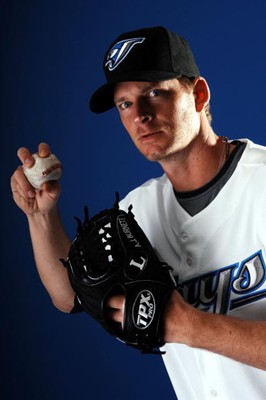 The ideal trade for Jake Peavy has become a harder than originally expected task. Padres GM Kevin Towers practically wrote the book on how not to trade what should be one of the most valuable commodities by keeping virtually every step of these negotiations front and center in the press. The talks may rekindle, but the Braves and GM Frank Wren will have the option of pursuing A.J. Burnett and other free agent hurlers. Wren will certainly look to provide at least two hurlers who can provide some innings, perhaps the White Sox Javier Vasquez could fit that bill.
Burnett, who turns 32 before the season, is clearly the Braves first choice as an ace. As Braves.com’s Mark Bowman pointed out last week, Burnett’s agent said a fifth year was not necessarily the make or break point. An 18-game winner a year ago, he also fills the role of ace starter which Atlanta is seeking this winter. Expect the Braves to make a big offer to acquire his services.
Atlanta is also faced with decisions on a trio of starters from last season. Tom Glavine and John Smoltz each have to determine their plans on pitching after testing their surgically repaired arms. I have my doubts that Glavine will decide to play on, while Smoltz has proven that you just can’t count him out. If it comes down to being a starter or reliever though, I don’t expect to see Smoltz putting on the uniform to serve as a set-up man next season. Then there is Mike Hampton, who showed he something left to offer after two and a half seasons of injuries. Jerry Crasnick over at ESPN noted that Hampton and his agent are seeking a one-year deal to re-establish his value in the market moving forward. Would the years spent on the sidelines lead him back to Atlanta to do so?
Power hitting left fielder
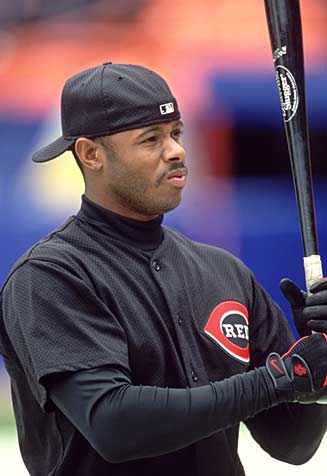 Depending on how everything shakes out with some of the other pursuits this winter, the Braves seem to be looking for a righty hitting middle of the line-up bat to stick in left this season. There are a range of options that starts with free agent Pat Burrell (whom the Braves will almost certainly pass on for his defensive liability and history of foot problems) and including the rumored to be available Jermaine Dye of the White Sox.
If you open the running to include left-handed hitters then you start to get some interesting names. Raul Ibanez, who is not interested in becoming the full-time DH for Seattle, and Ken Griffey Jr. top my list of candidates. Ibanez is a consistent performer (averaging 113 RBI over the past three seasons) who hasn’t exactly been in a hitter’s paradise in Safeco Field.
Age and injury combine to temper the expectations from Griffey, who combined to hit .249 with 18 homers and 73 RBI in 143 games with the Reds and White Sox last season. Still, a short term pact with incentives could be a strong option if other free agent options or trade alternatives become too costly in one form or another.
Bullpen reinforcements
The pen was a sore spot yet again for Atlanta last year. It seems like that theme has run through each of the last three seasons. The Braves do have a set closer at least, with Mike Gonzalez anchoring the ninth innings. Things are somewhat dicey after that though. Rafael Soriano is due a huge pay raise ($6.1 million) as part of the two-year deal he signed before last season and will have to prove he can stay healthy coming off just 14 appearances in 2008. Peter Moylan will be coming back from Tommy John surgery, and much is expected of that duo to solidify the late innings in front of Gonzalez.
Atlanta is interested in bringing back lefty Will Ohman, who struggled late but was one of the most important arms last season. Another lefty will be important, as I’m not sure how waiver claim Eric O’Flaherty fits into those plans, but I’m sure that Wren will seek as many options as possible. Ohman and Blaine Boyer finished near the top of the pack in overall appearances, so the Braves will look to add some reliable depth where possible. If there’s ever a place where some trades will happen, I expect it to be in the relief department.
Kick the tires on some available shortstops
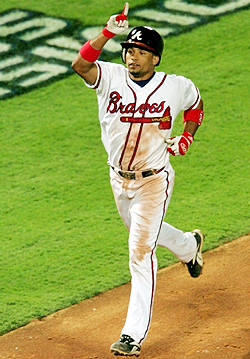 For a team that has a young and multi-talented shortstop already, there have been more than a few rumors out there that the Braves will go back to one of their former shortstops this winter. What started with the potential trade of Yunel Escobar (and several others) for Jake Peavy has turned into the potential homecoming of Rafael Furcal, or perhaps Edgar Renteria. Of course, the Braves may not make it to the table for either one – so consider this simply a cursory examination of the available.
A healthy Furcal would be a boost to the top of the line-up, providing a lead-off hitter that has not been present since his departure three seasons ago. The money and years would have to be right, and with the bad back that cost Furcal much of last season, it is hard to say the Braves will be a major player in this sweepstakes. The American League hasn’t seemed to be the place for Renteria on two occasions now. It was just 2007 when he hit .332 for the Braves, so who’s to say the down season with Detroit spelled the beginning of the end?
With a week’s worth of prep time between now and the Winter Meetings in Vegas, many things could change. Wren could wrap up some of his shopping before he heads to Nevada. The Braves figure to have an interesting off-season either way.
Till next time,
G-Mc
What’s the price tag for Teixeira?
I’m going to make a departure from talking about the quest for the holy rotation, and take a moment to look at a free agent race the Braves will not be taking part in. That would be the courting of premier first baseman Mark Teixeira.
There have been a few rumors, but nothing really to report in the way of offers just yet. With plenty of time left, and the Winter Meetings still a couple of weeks away, the teams that are serious about signing Teixeira are going to have pony up some serious cash for a long term commitment.
It’s been reported that Miguel Cabrera‘s 8-year $153 million contract is thought to the jumping off point for any offers submitted for Teixeira’s services. It seems logical to me. Teixeira’s physical conditioning and gold glove defense add two aspects that are not present in Cabrera’s list of attributes. Statistically, Cabrera holds the edge in career batting average, at .309 to Teixeira’s .290. Otherwise Teixeira has the lead in both homers (203 to 175) and RBI (676 to 650). The two players are practically identical in OBP (Cabrera leads .381 to .378) and dead even in slugging (.541). For those wondering, Teixeira has played in 24 more games, so this statistical analysis is pretty spot on.
The biggest difference (on paper anyway) in the two players is Cabrera being three years younger than the 28-year old Teixeira. While an eight year deal is likely to see Teixeira give what should be the prime years of his career for the club that signs him, it is worth noting that he has already turned down an 8-year $140+ million extension from the Texas Rangers. That prompted the trade that brought him to Atlanta in July of 2007.
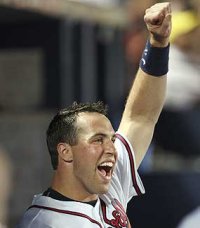 Atlanta GM Frank Wren stated that the Braves made Teixeira and agent Scott Boras an offer that would have given the first baseman a salary that was among “the highest in baseball.” It seems pretty clear after the trade with the Angels that it was likely the length of contract where the two sides could not come together. No one knows exactly what that means, but I’d project that any deal with the Braves was probably worth about $19 million per season. Not exactly underwhelming in and of itself, but there may be a team out there willing to pay more. If knowing that the previous offer was an eight-year pact, would the Braves go shorter in duration? We may never know.
What I do know is that the Braves traded a considerable bundle of talent to the Texas Rangers, a team which has gotten markedly better rather quickly. They may even trade what was once the center piece of the deal, Jarrod Saltalamacchia, this off-season. They have plenty of depth at catcher. Anyway you look at it, the Rangers made off much better than just receiving compensation picks in next years draft. Shortstop Elvis Andrus hit .295 with 54 stolen bases at AA, while starter Matt Harrison went 9-3 with a 5.49 ERA in 15 starts for the Rangers.
This is the point I would usually stop because I’ve seen enough, but there were two more prospects in that deal. Perhaps the brightest spot for Texas will be righty Neftali Feliz, who won 10 games at two stops and struck out 153 batters in 127.1 innings. More sickening? He surrendered just three homers in doing so. Lefty Beau Jones looks destined as a career in relief, but his low to mid-90s fastball and plus curveball show it could become a nice piece of the puzzle in Arlington within the few years.
One of these days, I am going to stop laying out the merits of this deal in hindsight. It was a risk/reward deal from the beginning, and the Braves gave themselves at least two shots to win with Teixeira. It didn’t work out. Not all trades do.
Getting back to the subject at hand, the race to sign Teixeira looks to have at least five possibilities that we know of. The Angels, Boston Red Sox, New York Yankees, Washington Nationals – as of yesterday, and perhaps the Baltimore Orioles. Rest assured though, we all know that the words “hometown discount” will not be factoring in to any deal for the last two teams on that list. And the word “discount” will not be making an appearance in any deal Teixeira ends up signing… in case you were wondering… which you shouldn’t be at this point.
It’s hard to handicap the sweepstakes in my view. I could see Boston. I could see a return to the Angels. Then the Nationals had to go and make me wonder. One place I don’t see being Teixeira’s plans is the Bronx. He just doesn’t strike me as a New York kind of guy. Then again, a teary-eyed Jason Giambi didn’t when the Yankees bounced Oakland out of the post-season in 2001. I reserve the right to be wrong.
Ok, I’ll say that Mark Teixeira is a member of the Boston Red Sox.
Merry Christmas Red Sox Nation.
Till Next time,
G-Mc
Damn Yankees? You bet…
I certainly won’t be the only scribe writing on behalf of a club that will be hard pressed to sign a premier front of the rotation starter, because the New York Yankees are throwing more than their allowance out there to build a strong squad for that new stadium you may have read about.
We’ve seen the Jake Peavy saga cool off considerably, with the Braves publicly stated that they will being “moving on” to fill their needs. At least for the time being. Numerous reports have shown that the Yankees are going to be setting the bar quite high when it comes to Grade-A starters. Take their reported offer to CC Sabathia for example – 6-years and $140 million. How do you think the Milwaukee Brewers feel about that? Not so great, but this is nothing new when it comes to the Yankee way.
Maybe the folks in Wisconsin haven’t been affected directly by the Yankees persuing their free agents, but you can rest assured that all of baseball has felt the effects of big money Bronx deals. You can chalk the Braves up for one tough off-season when it comes to bringing in their new starting pitchers.
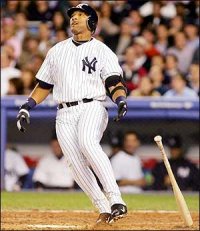 The Braves have lost free agent players to the Yankees in the past five years, including Gary Sheffield, Jarrett Wright and Kyle Farnsworth. This year, they will be competing for what looks to be A.J Burnett and Derek Lowe. Reports have right-hander Ryan Dempster heading back to the Chicago Cubs for a 4-year $52 million deal. If you do the math between the Sabathia offer and the Dempster deal, you are starting to get a pretty good idea what the years and the money on Burnett will be. Throw in the fact that he can openly shop that 4-year $54 million deal that Toronto had on the table. It boils down to the simple fact that every agent has to love: If you can get the Yankees involved then you can make your client a rich(er) man.
Never to be outbid, even when they are bidding solely against themselves, the Yankees have taken to the offensive and are preparing an offer that rests somewhere around 5-years and $80 million for Burnett’s services. When reading that the Steinbrenner boys plan to follow in their father’s footsteps of setting the bar rather high when it comes to player contracts, it became apparent that not only were the Yanks going to be players in the free-agent market but that they may well end up owning several of the shiniest pieces this off-season.
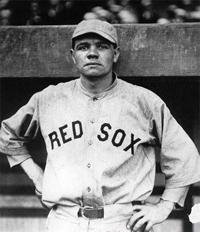 The Yankees have taken this route for years, signing free-agents to big deals, rewarding their stars with big deals, trading the farm and taking on big contracts of stars that other clubs seek to unload. Maybe all this started when they purchased Babe Ruth? None of this necessarily should make them the real life pirates of baseball (all apologies to the Pittsburgh franchise). The city and the organization simply likes to win and they have the money to make happen more quickly that every other team in baseball. Put those two things together and it always leads to interesting storylines and sometimes whimsical back-and-forth fun. It also serves to make them easily hateable for many. Hard economic times or not, the Yankees are going to be spending aplenty this winter.
So what does all this mean for Atlanta?
Having somewhat put the lid on the Peavy discussions (believe that if you like), the Braves will have the tough task of assigning a value to their future and signing one of these star pitchers. I’m starting to think that if Dempster signs with the Cubs, Sabathia and Burnett sign with the Yankees, and Lowe opts to go back to Boston (for example), the Braves will have to get creative via trade or start kicking the tires on Ben Sheets.
It could play out the way I just outlined. Or it could turn back around, leading the Braves and Padres back to the table to complete that long-running trade rumor, and Burnett or Lowe to different pastures. Atlanta could end up finding an entirely different trading partner to boost the rotation with. That’s the fun of the the off-season.
Who’s ready for those Winter Meetings?
Till next time,
G-Mc
Deal or no deal?
Sheez. Somebody had to jump the gun and announce the trade was in the final stages and go and have all of us thinking we would have a big day to blog about. Scott Miller of CBS Sportsline wrote a blog last night that had the Padres approaching Peavy to waive his no-trade clause and accept a deal to the Atlanta Braves. Based upon the fact that absolutely no one else was reporting it, and no one I knew had mentioned the trade being a done deal, I knew that it might just be getting our hopes up.
I’m just ready to see this thing happen… because I’m impatient, if nothing else.
Look, the deal may happen yet, and I have a feeling we will see the Braves coming away with their ace when it’s all said and done. Miller’s piece had the Braves giving up the long rumored package of Yunel Escobar, Gorkys Hernandez, either Charlie Morton or Jo-Jo Reyes and perhaps a fourth player. The new information was that righty reliever Blaine Boyer or one or two minor league left-handers (Jeff Locke among them) were on the table as well.
So where did all this rumor about catcher Tyler Flowers being in the deal come from?
Ah, thank you Ken Rosenthal of FoxSports and RotoWorld for coming to my rescue. When I thought all was lost. Here’s the rumor on Flowers.
The excitement of the Arizona Fall League has been in full force when it comes to the performance of two Braves prospects. Tommy Hanson, who has been wowing anybody who sees him pitch, and the heavy-hitting Flowers. The latter of these two is a relative new comer on the radar for many Braves fans, but I’m here to tell you that he has some serious power.
Last spring, I watched Flowers put on his batting practice displays that wowed every single teammate. Literally, heads turned as Flowers deposited baseballs into the far reaches of every spring training facility he visited. Braves beat writer Mark Bowman recorded the great first impression Flowers made on Braves manager Bobby Cox in just his first big league camp.
All that said, I’m happy with the framework rumored to be going in this deal. It’s not nearly as prospect laden as the Mark Teixeira deal and could net the Braves one of the best starting pitchers in baseball for as long as five years. You see, that was my fundamental problem with the Teixeira trade two seasons ago. There was no security that Atlanta would be able to retain Tex beyond 2008. And sure enough, a king’s ransom was paid for the eventual acquisition of Casey Kotchman.
This Peavy deal is a long term commitment to winning that I believe, among other things, will attract other free agent pitchers to the Braves based on the fact they are attempting to build a contender. One central theme of any trades the Braves make will be, does it make our team better in the long term (there’s that phrase again)? If the answer is yes, expect to see the deal happen. If the answer is now, then expect the Braves to pursue pitchers in the free agent market to check those off-season needs off the list.
Losing a shortstop like Escobar is bittersweet, but I think the Braves have scouted and developed enough players in their day to weigh the pros and cons of letting the young Cuban infielder go in favor of the 2007 Cy Young Award winner. Atlanta has to give in order to get, and this package centered around Escobar seems to be far and away better than anything the Chicago Cubs have managed to muster on their own. Throwing in too many other prospects would take Atlanta right back to the Teixeira trap though, so Wren is going to be cautious not to go overboard just to make a deal happen.
If this trade goes down, Atlanta will then turn its attention to signing at least one more top of the rotation arm from a list that is headlined by A.J. Burnett, Derek Lowe and Ryan Dempster. Of the three, Burnett provides the impact arm that would combine with Peavy to give the Braves a dynamic1-2 punch that is built for the post-season. He’ll probably cost at least $17 million a year too.
The fun doesn’t stop there, as shortstop would be in need of an upgrade following the potential Peavy deal. Free agents Rafael Furcal and Edgar Renteria have both spent time in Atlanta and make a certain amount of sense. Furcal’s tools are far better than Renteria’s at this stage of the game, but Renteria has shown himself to be a better all around performer in the NL. There will also be a major cost differential between the two as well. Of course, that’s not a foregone conclusion by any means. The Braves could seek a trade or go after a completely different shortstop altogether.
Once the first piece falls, it will allow the Braves to start making other moves. Now we wait to see if Peavy is the first piece or if the free-agent market will produce the opening transaction of the off-season.
Till next time,
G-Mc
And now for the best Braves deals…
When last we left off, we were looking at some of my least favorite trades from the past 20 years or so. There’s going to be one deal that goes a year outside my little bubble, but it’s not my fault that I keep getting older but this trade looks better seemingly every season. Heck, it might be one of the best trades in baseball history.
We’ve seen the dealing of Jermaine Dye, Adam Wainwright and a boatload of young talents for Mark Teixeira, but now let’s take a good look at some of the deftest maneuvers the Braves have pulled in the trading game. Here are my top 5 favorite Braves trades of the last 20 years:
5. Tony Castillo & Joe Roa to the New York Mets for Alejandro Pena
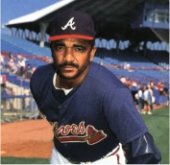 This is the kind of trade that every team looking for bullpen help in late August wishes they could pull off. Pena’s veteran presence was inserted into a bullpen that was in dire need of a stopper, and boy did it work. Pena responded by stabilizing the late innings in September and continuing to slam the door in October. Going 2-0 with 11 saves in 15 games, Pena’s presence helped the Braves stave off the Los Angeles Dodgers to win the first 14-consecutive Division titles. He made a good enough impression to be brough back to share in the joy of the Braves World Series victory in 1995.
4. Jimmy Kremers & Keith Morrison to the Montreal Expos for Otis Nixon & Boi Rodriguez
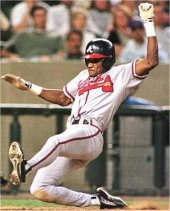 I still miss the days of Otis Nixon and Deion Sanders seemingly running amok at the top of the Braves line-up. The Nixon trade was a superb deal in the spring of ’91 for Atlanta, giving them to have a true lead-off hitter and allowing Bobby Cox to move Ron Gant and his 30 homers into the middle of the order. Kremers never played in the majors again after his 29 game stint with Atlanta in 1990, but Nixon set a franchise single season steals record and was an important part of the Braves success in the early 90s. Then there was the matter of a certain catch during the pennant drive in 1992. Ask Andy Van Slyke if he remembers hat one.
Watch the catch for yourself by Clicking Here
3. Dan Meyer, Charles Thomas & Juan Cruz to the Oakland Athletics for Tim Hudson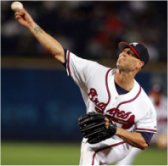 I remember seeing this trade scroll across the bottom line during Sportscenter and wondering just how John Schuerholz pulled it off. The Braves acquire one of Oakland’s famed Big Three aces, and gave away a flash in the pan outfielder, a middle reliever and a solid pitching prospect. None of the three were serious pieces of Atlanta’s future and it still boggles the mind to think that Oakland would trade a pitcher the ilk of Hudson for that package. Consequently, none of the three figured in Oakland’s plans either. Meyer was waived this winter after struggling to make good on his promise. The A’s dealt Cruz away, but poor Chuck Thomas turned back into a pumpkin and has not appeared in the Bigs since batting .109 in 30 games in 2005.
2. Melvin Nieves, Vince Moore & Donnie Elliot to the San Diego Padres for Fred McGriff
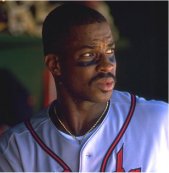 Want to know how the Braves held off the San Francisco in an exciting down the wire pennant race in 1993? Well you can thank the San Diego Padres donation of Fred McGriff as the chief reason Atlanta caught fire and grabbed their third straight NL West crown. McGriff served as a part of the 1995 World Series winners and always provided the clean-up bat for four seasons in a Braves uniform. This trade was a big part of the Padres fire sale, that still to this day comes up whenever a team puts two or more stars the trading block. Too bad the trade of Mark Teixeira did not bring the same kind of return for Atlanta, because the price was much more than San Diego acquired for McGriff.
1. Doyle Alexander to the Detroit Tigers for John Smoltz
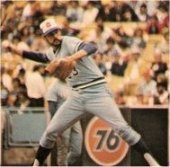 The trade that perhaps started it all. Well this trade and some excellent scouting and drafting I’d say. I pull this trade into the 20 year mark despite its 1987 deal date because Bobby Cox was the general manager who pulled it off. In other words, it’s a trade that helped build the core of the team. It netted a future Hall of Famer and gave the Detroit Tigers a boost since Alexander kicked into full gear after his trade (9-0, 1.53 ERA in 11 starts). Too bad the boost ended with Alexander getting shelled in his two post-season assignments (0-2, 10.00 ERA). Smoltz has become more than the Braves could have ever expected, and the foundation of the team for the better part of two decades.
Well those are my favorite deals, at least the last 20 years… or so.
Till next time,
G-Mc
I’ll trade you, but no take-backs!
As those that have followed the Braves rise to the top and subsequent slide back to the middle of the pack over the past two decades, one would notice that many of the key acquisitions during this time have come via the trade. It is a part of baseball that garners anticipation, excitement and sometimes disappointment for an organization and its fans.
I thought it would be fun to look at some of my favorite Braves trades, and some of my not-so-favorites, because we may have some trading fun to talk about here in the near future. I always like to hear the bad news first, so I can enjoy the good news a littler more… or at least temper my expectations. Here goes:
Top 5 Least Favorite Braves Trades:
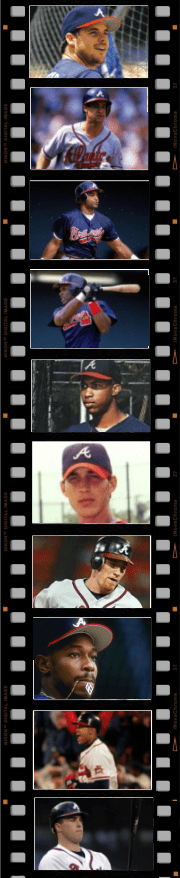 5. Ryan Klesko, Bret Boone & Jason Shiell to the San Diego Padres in exchange for Reggie Sanders, Quilvio Veras & Wally Joyner
Sanders was utterly terrible in his one season with the Braves while Veras tore an ACL and never appeared in the majors again after Atlanta. Despite there being no way to know these things would happen, Klesko, just 28 at the time, was a part of three World Series team and a product of the system. Boone had been the big off-season acquisition just one season earlier, so why trade these central pieces coming off a World Series appearance?
4. Jermaine Dye & Jamie Walker to the Kansas City Royals for Michael Tucker & Keith Lockhart
Here’s one where you can just say,”what if?” What if the Braves had held on to Jermaine Dye? Would he be the same player he became in Kansas City after some struggles? He’d more than likely have contributed at least as much as Tucker (the 10th overall pick in the ’92 draft) did in his two season with Atlanta. Lockhart proved to have the most staying power, lasting six seasons as a chief reserve and pinch-hitter. Hardly an even up swap for Dye and his 286 homers since 1997.
3. Adam Wainwright and Ray King to the St. Louis Cardinals for J.D. Drew and Eli Marrero
This is one reason the Braves find themselves looking for two front-line starting pitchers this off-season. J.D. Drew has moved on to greener pastures twice since having a career year for Atlanta in 2004. And I’m just going to say it now, Drew was not the second coming of Mickey Mantle. All Wainwright has done is prove the scouts that signed him right, developing into a staff ace by the age of 25. Too bad he doing so for the St. Louis Cardinals.
2. David Justice and Marquis Grissom to the Cleveland Indians for Kenny Lofton and Alan Embree
This is the ultimate in head-shakers. I couldn’t fathom the logic as a teenager and I still struggle to find anyone who would do this deal. Granted, Lofton was the ultimate lead-off hitter in 1997 and not the rent-a-player of the past seven or eight years, but still. Justice, who’s homer gave the Braves their lone World Series title of the 90s, was coming off an injury-plagued season but was still a potent middle of the order threat. Grissom was a consummate professional and still, in my opinion, every bit the center fielder Lofton ever was… and then some. To make matters worse, all three men would be playing in the same outfield in 1998… when Lofton signed a free-agent contract with Cleveland. Ouch. Atlanta did get 86 appearances out of Embree though. Heck of a silver lining.
1. Jarrod Saltalamacchia, Elvis Andrus, Matt Harrison, Beau Jones and Neftali Feliz to the Texas Rangers for Mark Teixeira and Ron Mahay
We have not even seen this trade bear fruit for the Texas Rangers, but it may be the deal that just keeps on getting worse for Atlanta. Teixeira was dealt away for Casey Kotchman and Stephen Marek almost a year to the day later. Would you do that prospect buffet deal for Kotchman? Me neither. Of all the deals I’ve covered here, this is a trade that simply should have never been made. Teixeira turned down an 8-year $140 million extension from the Rangers and I would have to say that common sense logic would dictate the Braves would have to pony-up even more to keep him. Mahay bounced to Kansas City for a richer deal than the Braves wanted to give him, so the Braves really came out of this deal having seriously depleted their rich farm system for a calender year of Teixeira and 30 appearances from a 36-year old left-hander.
In Closing…
 The Braves may not have known that Teixeira had already turned down that extension, but this trade was unable to push Atlanta in the play-offs. Maybe it was just all the poor luck of injuries this season that forced Frank Wren‘s hand when it came to trading Teixeira. Maybe it was Scott Boras and his hope of a $200 million pay-day for his client that forced the deal. If it underscores anything, it is that there are no promises in the game in this day and age. Even a player who spent his college years in Atlanta wants what he has coming. That’s why Boras claims a nice finder’s fee for that big contract Tex has coming.
So who is ready for a big trade this off-season?
Up next, my Top-5 Favorite Braves trades of the past 20 years.
Till then,
G-Mc
More award winning predictions (NL-style)…
The start of the World Series reminded me that I have just a few short days to predict my NL Award winners. Otherwise, I will find myself wrapping the actual winners or trying to convince people that I really knew “he was going to win that!” I’ll stick with beating the clock.
National League Most Valuable Player
Albert Pujols – Maybe I’m just trying to predict this guy takes home the trophy because there is a very good argument that we owe him a few of those that went to that Bonds guy. Regardless, Pujols has assaulted opposing pitchers since the first day he stepped in the box for the St. Louis Cardinals. Stat-line please….
|
AVG |
G |
AB |
R |
H |
2B |
3B |
HR |
RBI |
SB |
OBP |
SLG |
|
.357 |
148 |
524 |
100 |
187 |
44 |
0 |
37 |
116 |
7 |
.462 |
.653 |
It’s hard to imagine a player who started off a career any hotter that Pujols. A near win for the NL batting title, in addition to be among the Major League leaders in home runs, RBI and of course running away with the best OPS (1.114) in the senior circuit are all reasons that Pujols does what Ryan Howard could not. Maybe my entire argument for Pujols as the best hitter in the National League leads me to vote for him, simply because he does his thing every year… and he’s more than a one trick pony. I smell a segway.
Runner Up: Ryan Howard – Yes, the big Philly first baseman lead the majors in homers (48) and RBI (146), and turned in a monster September that helped the Phillies grab the NL East flag. BUT, I can’t see how the 199 strikeouts (for a second straight season I might add) is an MVP kind of stat. I’d argue that if you take away Chase Utley and Jimmy Rollins and that supporting cast, then Howard’s ability to produce is diminished immensely. It’s hard to say that Howard is more valuable to the Phillies than Utley in my book. The .251 batting average and iron glove defense doesn’t exactly win me over, either.
Here are a few other things while I’m on the topic: Howard finished sixth in the NL in slugging percentage (.543) despite his monster homer total. How about a 47th place finish in on base percentage (.339)? If you add the two together, you find a hitter who is nestled between Andre Ethier and Brad Hawpe. That’s hardly MVP-caliber company.
National League Cy Young Award
Tim Lincecum – This kid, yeah, KID, is flat out awesome. Breezing through the minor leagues and cutting his teeth with the Giants last season, Lincecum established a degree of dominance that was not matched by any other pitcher in the National League. Don’t believe me? I’ll show you:
|
W |
L |
ERA |
G |
GS |
CG |
SHO |
IP |
BB |
SO |
WHIP |
|
18 |
5 |
2.62 |
34 |
33 |
2 |
1 |
227 |
84 |
265 |
1.17 |
I’m looking at all the other statistical accomplishments of more veteran hurlers, like Johan Santana and the Arizona win-machine Brandon Webb. Even guys like Ryan Dempster and Roy Oswalt ending up having quality seasons, but there was little to convince me that Lincecum didn’t embody everything that the Cy Young Award has come to be known for. A season of dominance.
Runner Up: Johan Santana – I’d say the trade for Santana may have been the only thing that kept the Mets in the race the season. Managerial changes, injuries to John Maine and Orlando Hernandez, seeing Pedro Martinez continue to devolve, Oliver Perez coming back to earth, losing Billy Wagner…. I could go on and on. The bottom line is, Santana (16-7, 2.53 ERA, 206 K) should have won 20 games last season, were in not for some blown saves in what became a volatile Mets bullpen. There is plenty of reason to expect more of the same from the Mets ace as they move across the street.
National League Rookie of the Year
Geovany Soto – The Cubs have themselves a solid force behind the plate in young Mr. Soto. While breaking into the league this season, Soto showed a mastery behind the dish as well as when he had the bat in his hands:
|
AVG |
G |
AB |
R |
H |
2B |
3B |
HR |
RBI |
SB |
OBP |
SLG |
|
.285 |
141 |
494 |
66 |
141 |
35 |
2
|
23 |
86
|
0
|
.364 |
.504 |
Were it not for our own Brian McCann here in Atlanta, Soto would have been leading all catchers in most offensive categories. Second to McCann in both doubles and SLG, Soto tied his Atlanta counterpart with 23 homers and finished nine RBI’s off the pace of Benjie Molina‘s lead. I’d say his season was by in large a tremendous success. Is this only the beginning?
Runner up: Jair Jurrjens – In a season that was marked by notable injury after notable injury in the Braves rotation, Jurrjens held his spot from bell to bell. And what a first full season it was. Coming over in a trade from the Detroit Tigers, the Braves installed a 13-game winner and nearly 200 innings into the rotation, when all they were expecting was a man to audition for the fifth spot in the rotation last spring.
National League Manager of the Year
Lou Piniella – We now know how the story ended this year, but Sweet Lou wasn’t to blame for the under-whelming performances of his starting pitchers in the post-season. Yes, he had the big payroll and the star-laden team, but Piniella brings a fire and definite leadership to the fold as the skipper of the Cubs. He’s got as good a shot as anyone to help this team break that dreaded curse. You know, the one that was all but history this year.
There you have it, all the winners I can give you from the National League. Anybody agree or disagree with those? I’d love to hear it.
Till next time,
G-Mc
Time to hand out the hardware… (AL Winners)
The close of each season is a great time to reflect. When game 162 goes final, it’s another year in the books. There’s no doubt in my mind that 2008 was a season unlike any other, for a host of storylines and pennant races that made it an historic season. Now we get to focus on what players defined the season and make a few award-winning predictions. Here are the American League’s lucky recipients.
American League Most Valuable Player
Dustin Pedroia – While you can make the point that the line-up certainly helps, you must also take a close look at the diminutive second baseman and notice one important factor. He can flat out hit. Just look at this stat line:
|
AVG |
G |
AB |
R |
H |
2B |
3B |
HR |
RBI |
SB |
OBP |
SLG |
|
.326 |
157 |
653 |
118 |
213 |
54 |
2 |
17 |
83 |
20 |
.376 |
.493 |
No, he isn’t going to lead the league in homers and RBI, but I’d give him a fighting chance at a slew of other categories. Those 20 stolen bases come against only one time being caught, so well rounded would be a great way to sum up Pedroia’s game. While the little man doesn’t always get his due, I believe 2008 may be a year that line of though gets thrown right out the window.
Runner Up: Josh Hamilton – It’s probably one of the greatest redemption stories in all of sports. And it is also one that is still being written on a daily basis. Overcoming personal demons to become a one-man wrecking crew for the up and coming Texas Rangers, Hamilton lead the AL with 130 and just five homers off the pace with 32. Speaking of homers, I don’t know too many people that will be forgetting that showcase Hamilton provided in Yankee Stadium during the All-Star festivities.
American League Cy Young Award
Cliff Lee – There are candidates who enter each season with the potential to take home the Cy Young award, whisking through the season and cutting down opponents on the way to a 20-win season. If I’d asked you to compile a list of these names last March, then I seriously doubt the inclusion of Cliff Lee on anybody’s manifest.
Then out of nowhere, Lee climbs off the scrap heap and back into the Indians plans for the season and well beyond. Without boring you with any further anecdotal quips about reclamation projects, here is Lee’s work this season:
|
W |
L |
ERA |
G |
GS |
CG |
SHO |
IP |
BB |
SO |
WHIP |
|
22 |
3 |
2.54 |
31 |
31 |
4 |
2 |
223.1 |
34 |
170 |
1.11 |
So maybe I will insert those tales of woe that defined Lee’s 2007 now. This amazing Cy Young season comes just one year after he found himself back in the minor leagues and saddled with a 5-8 record and a 6.29 ERA. Refinements to his mechanics and the ability to attack the strike zone can be heralded as the top reasons for the renaissance that occurred here. Lee walked just 34 batters this season as opposed to 36 in 97.1 innings a year ago. His performance made it easier for the Tribe to trade away last year’s Cy Young award winner, CC Sabathia.
Runner Up: Francisco Rodriguez – I guess 62 save seasons just don’t go as far as they used to. What am I talking about?! That record setting effort certainly isn’t lost on this humble baseball scribe, but K-Rod’s work doesn’t come as a complete shocker like Lee. In other words, his established track record of ninth inning dominance made him a prime candidate to take a shot at Bobby Thigpen’s record. Well, he can check that one off his list now. Besides, that saves record is going to make him a very rich man this off-season, with or without a Cy Young trophy.
American League Rookie of the Year
Evan Longoria – This guy is going to be a superstar. With the emergence of the Ray as a force what was perhaps baseball’s toughest division to win (if your team isn’t located in Boston or New York), Longoria will serve as Tampa Bay’s version of David Wright. Who knows, he might even be better. Stat line, please:
|
AVG |
G |
AB |
R |
H |
2B |
3B |
HR |
RBI |
SB |
OBP |
SLG |
|
.272 |
122 |
448 |
67 |
122 |
31 |
2 |
27 |
85 |
7 |
.343 |
.531 |
Runners Up: Jacoby Ellsbury & Alexei Ramirez
Manager of the Year: Joe Maddon – Was there any question about this one? The Play-offs have been a great time to catch up with the stories that Maddon and the Rays next goal was supposed to be finishing about the .500 mark. I’d say the boys from Tampa Bay can set a new goal next season. How about repeating as AL East Champions? It truly came from nowhere, but the mind behind the Rays’ success deserves all the kudos in the world for this transformation. The cast of amazing young talent may be the power driving this post-season run, but the man behind the wheel did an amazing job this season.
Tune in for the National League next time.
Till then,
G-Mc
Swing and a miss!
When you hear somebody mention 200 strikeouts being achieved, usually you think of a pitcher who is hitting a milestone marker for excellence in a particular season. Some guys even do it as a annual right of passage (i.e. John Smoltz), but I can tell you unequivocally one scenario in which you do not want to be racking up 200 strikeouts in a season…
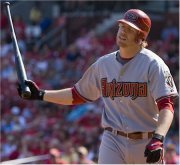 Or you could just ask Arizona’s Mark Reynolds, who struck out for the 200th time in the second inning of the Diamondbacks contest against Joel Pineiro of the St. Louis Cardinals on Thursday. That sets a new mark for futility that sluggers had somehow managed to avoid in the entire storied history of Major League Baseball. Let that soak in for a minute. Reynolds has done something that no other man in the history of the sport has ever done! When do you think the next time that could possibly happen again could be?
How does this weekend work for you?
Philadelphia’s Ryan Howard, who is known throughout the game for his mammoth home runs and frequent u-turns at home plate, sits on 196 punch-outs this season. So Reynolds may not be alone at the top, if you can call it that, for very long. Howard set the single season record last year, when he fanned an eye-popping 199 times in the regular season and tacked on seven more for good measure in the Division Series. One could make an argument that Howard’s 206 would be the actual mark for a calender year, done in only 147 total games.
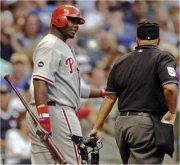 Reynolds finished Thursday with 201 total strikeouts in his 148 games, so if the slight difference in his rate of futility and Howard’s is any consolation… nevermind. On a more serious note, I find it fascinating that hitters were able to avoid the mythical 200 K mark in a season for more than 130 years. As the game has evolved and power has been pushed to the forefront of seemingly everyone’s evaluation of a hitter’s “strength” and/or value to his club, this single season record has continued to climb.
The last 50 years has seen the most shuffling at the top of the list for the single season strike-out record holder. In fact, only three men held the slot from 1884 to 1955. The first man to hold the single-season record was Sam Wise, who set the bar at 104 during that 1884 season while playing for the Boston Beaneaters (now the Atlanta Braves). Gus Williams surpassed Wise in 1914 and went on to hold the record through the 1937 season after striking out 120 times for the St. Louis Browns. One year later, Williams was out of baseball.
Another Brave took the reigns in 1938. Vince DiMaggio, of the then-Boston Bees, would hold the mark of 134 until 1955. From there, eight men would emerge to set a new level swinging and missing over the next 53 years. Bobby Bonds and his 189 whiffs in 1969 set the mark for the longest period of time for any one player (34 years) before the torch was passed to Adam Dunn in 2004. Dunn notched a head-turning 195 punch-outs and held the record for a brief three year trial run. Then there was Howard and you know the rest.
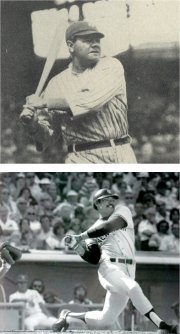 It’s pretty clear that Howard is going to continue his shtick of long balls and long swings over the course of his career. In his 569 career games, Howard has accumulated 689 punch-outs. Most dead-ball era historians probably considered Babe Ruth‘s 3-strike exploits to be the pinnacle of decadence that flew in the face of fundamental baseball. Ruth went down on strikes 1,330 times and was the all-time record holder until Mickey Mantle took him off the hook in 1964. Howard is on pace to obliterate that number by the time his seventh full season is in the books. Oh, and Ruth’s career was 22 seasons long, by the way.
Who knows, Howard could end up taking a swing, and I mean that very literally, at Reggie Jackson and his record of 2,597.
Digest all that, while I try to rid myself of my penchant for parentheses in literary settings.
Till next time,
G-Mc
 Changing Speeds