Tagged: Braves
Reports have Smoltz heading to Boston
Veteran right-hander John Smoltz appears close to a deal with the Boston Red Sox according to MLB.com’s Mark Bowman. An announcement could come as early as Thursday.
The
deal calls for a $5.5 million base salary with incentives that could
push the deal to $10 million based on performance, a Major League
source close to the negotiations told Bowman. Boston would like to use
Smoltz as a starter.
Smoltz, who will be 42 in May, has spent
his entire 21-year career with Atlanta after being acquired in a
mid-season trade with the Detroit Tigers in 1987. He was the last
player remaining from the Braves original worst-to-first season of 1991.
Boston would add Smoltz to an already strong rotation that includes Josh Beckett, Daisuke Matsuzaka, Jon Lester, Tim Wakefield and the recently signed Brad Penny.
Last
season, Smoltz went 3-2 in just six appearances before being shut down
with reconstructive shoulder surgery. Braves manager Bobby Cox spoke highly of Smolz’s progress in rehab while at the Winter Meetings in Las Vegas.
“I’ve never seen John so fired up about something in my life,” said Cox. “He loves
challenges, and he’s got a big one ahead of him. But what I saw for the
very first time out off the mound was incredibly good.”
Smoltz
had just completed his first throwing session off the mound in early
December in which he utilized all of his pitches, including his
assortment of breaking balls. Atlanta was hoping to gauge his rehab
further before making a formal contract offer.
During his time
in Atlanta, Smoltz became the first pitcher in history to win more than
200 games while also saving more than 150. He became just the 16th
pitcher in history to surpass the 3,000 career strike out plateau
against the Washington Nationals last April. An eight time NL All-Star,
Smoltz captured the Cy Young Award in 1996.
Losing Smoltz is the
latest in a series of disappointments for the Braves this winter,
having already lost out on the bidding for free-agent starter A.J. Burnett and infielder Rafael Furcal. Atlanta general manager Frank Wren also publicly pulled out of trade negotiations with the San Diego Padres involving 2007 Cy Young winner Jake Peavy.
Wren has stated on multiple occasions this off-season that he was monitoring the progress of both Smoltz and 300 game winner Tom Glavine, in hopes of bringing them back in 2009.
How Lowe can we go?
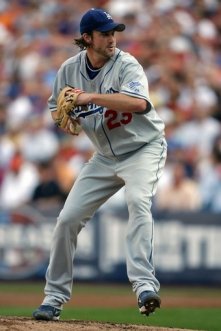 The really big contracts have already gone out this winter, but all the major players in the free agent pitching market are not yet off the table. Secondary pursuits should start to fill the empty seats for the clubs that missed out on the likes of CC Sabathia, and in the Braves case, A.J. Burnett.
Look, I’m just excited to see a pitcher who doesn’t go by two initials attracted some attention on the market. It was starting to get a little weird. Although, I bet Derek Christopher Lowe would be more than happy to go by “D.C.” if he knew it would land him the rumored $16 million per year over four seasons that he desires. Were it not for the fact that he will turn 36-years old in June, his track record and post-season experience would easily net him a bigger deal than Seattle handed Carlos Silva last winter (4-years and $48 million).
If the Braves were willing to go the distance in the Burnett bidding, only to fall short, then it would seem the money would still be available to put toward bringing Lowe to Atlanta. Injury was the question with Burnett, but age is the major point of contention for handing a multi-year deal to Lowe. His durability is not in question, however. Over the past seven seasons, Lowe has won 106 games and averaged 208 innings. Adding his veteran presence to that of Javier Vazquez and perhaps John Smoltz would give the Braves the experience factor. Throw in talented young right-handers, Jair Jurrjens and Tommy Hanson, and you could have the makings of a strong rotation. Tim Hudson will likely miss the entire 2009 season as he recovers from his Tommy John surgery.
Atlanta’s interest in Lowe has been tepid at best thus far. It does not rule out their involvement altogether. However, to get into the bidding for Lowe, Frank Wren would have to approach the Mets initial offer of 3-year and $36 million that Lowe has already rejected. Also working against bringing Lowe to Atlanta is his agent, Scott Boras. The Braves history of signing and even retaining Boras clients is not exactly inspiring. It is doubtful that Boras and his team view Atlanta as anything more than leverage at this point, useful for driving up the price the New York Mets or Boston Red Sox would be willing to pay. Those two clubs also fit a certain criteria that every free agent is looking for, the ability to win now.
As most GM’s do, Wren has other irons in the fire, including Japanese hurler Kenshin Kawakami. There are reports that he has narrowed his choices to the Baltimore Orioles, St. Louis Cardinals and Minnesota Twins. The AJC’s David O’Brien reports to the contrary after speaking with Kawakami’s agent this week. Perhaps Atlanta will remain in the mix. Kawakami will be 34-years old midway through next season, making him a few months younger than Hiroki Kuroda, who was signed to a 3-year $35 million deal by the Dodgers last winter. That price tag brings us back full circle to Lowe.
Though he may not be a clear ace, Lowe would fill Atlanta’s off-season goal of adding two quality veteran starters. Lowe is not Jake Peavy, but that ship sailed long ago.
Till next time,
G-Mc
Escape from L.A.?
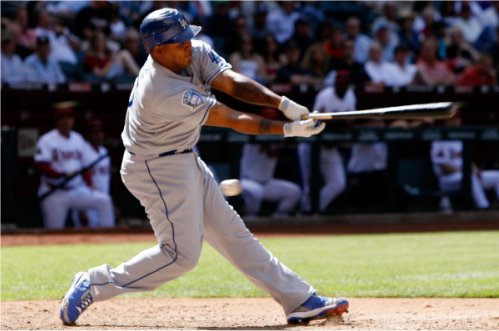 This Hollywood masterpiece doesn’t involve Kurt Russell reprising the role of Snake Plisskin, though some may theorize that Andruw Jones
don the eyepatch in an attempt to reverse his recent fortunes. Before
the new year could make it through its opening day, speculation has the
Los Angeles Dodgers trying to buy out and/or unload Jones and his
enormous contract.
It was just a week ago that we were watching everyone squash a rumored trade to the New York Mets for Luis Castillo.
Now reports are stating that Jones and the Dodgers have reached an
agreement that would defer the remaining 22.1 million owed over the
next several years. The club has agreed to trade or release Jones as
well.
Top priority in Dodgersland has been given to bringing back Manny Ramirez.
And why not? Ramirez seems to be hitting better with age. Getting the
slugger who reversed the team’s fortunes following his trade deadline
acquisition will no doubt take a large sum of the green stuff – and I’m
not talking new year’s collards.
Dumping Jones money, or at least breaking it into several years worth
of small payments rather than a lump sum should allow Los Angeles to
get to the business of getting to the table with Ramirez.I don’t have
to tell the average baseball fan that if the bitter long-term rival San
Francisco Giants are earnest in their decision to pursue Ramirez, then
it behooves Colletti to step things up and seal the deal.
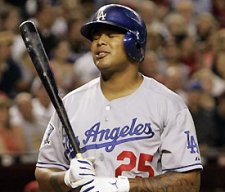 Following
the bouncing ball would point to the fairly obvious fact that L.A.
could save some money by unloading Jones to another team, but that
won’t be easy after he followed a .222-26-94 season with his horrendous
.158-3-14 campaign that was highlighed by injury for the first time in
a 13-year career. More alarming and dissuading for a potential buyer
would be the 76 strikeouts in 209 at-bats. Jones also missed out on
winning his 11th Gold Glove Award as well.
It would probably
be silly to go from those stat-lines to suggest that the Braves would
be an excellent place for Andruw to find employment if indeed he is
released from his duties out West. What could playing in Atlanta do for
Andruw now that it wasn’t doing for him in 2007 – his original
career-worst season?
The Dodgers have solved what became a rather expensive dilemma with
Andruw. No other team is going to be interested in taking on any
portion of his salary unless or until he proves he can be productive
again. You can probably safely assume that any interested club will
allow the Dodger to release and assume the majority of the deal and
then sign him for the Major League minimum.
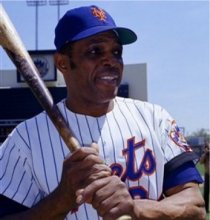 Homecoming stories haven’t been a source of happy endings in Atlanta as of late – Tom Glavine last season for example. But more to the point of once great center fielders in decline, take Willie Mays
in the Mets years for example. Anyone who saw Mays falling down in the
outfield and struggling to run the bases in his final years probably
sees the similarities between the two. What Jones may is the
opportunity to get his career back on track… something that Mays was
not allowed to do because of age and mileage. It is doubtful this road
to redemption would lead back to Atlanta – but I wouldn’t say
impossible.
At 32-years old this April, Jones should still be
in the prime years of his career. The opposite has shown the past two
seasons. Strikeouts have soared while his power numbers have hit the
skids. Another thing that soared to new heights was Jones’ weight last spring when he reported to his first Dodger camp. The fans definitely noticed. See for yourself.
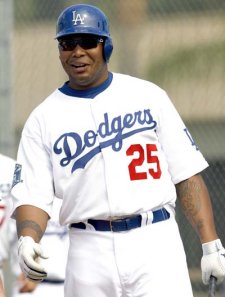 It got worse from there for Andruw, who was soon dubbed “tubbo” by the L.A. Times’ T.J. Simers.
He was the clever reporter who got Andruw to step on the scales to
register at 248 pounds. Yikes. Either way, Andruw’s usual relaxed
assuredness translated into a cavalier attitude in his new
surroundings. It was his complete lack of production made him anything
but a fan favorite. By the end of April, the smile that Braves fans
know as a Jones trademark could bring the blood of any Dodger fan to a
steady boil. Off-speed pitches became kryptonite and knee surgery
slowed the season to a crawl. Fast forward to September and the boys in
blue were making their playoff run without Jones, who essentially sent
himself home after a third DL stint.
Now Jones is down in
Aguilas, trying to get his entire career back on track this winter.
Various reports have stated that he is “looking forward” to his next
time out on the free agent market, while still others state that he has
slimmed down. Whatever the case may be, hitting .188 in half a dozen
games isn’t exactly lighting the world on fire.
To make
matters more tragic, I’ll suggest you spend some time on Youtube and do
a quick search for “Andruw Jones.” If you don’t find a Dodger fan-made
hate video within your first page of results, then you just aren’t
paying attention. Here’s one. And here’s another. Same game, but you get the idea.
If it was a knee injury that sapped his numbers last season, then Jones
will have to get things back on track and show the baseball world that
the reports of his demise have been greatly exaggerated.
Till next time,
G-Mc
Goodbye 2008, you will not be missed…
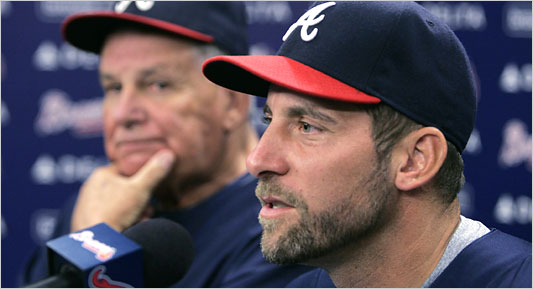
Based
on the kind of fun and excitement generated by press conferences like
the one above, there was no way that I could (in good conscience) call
yet another to wish this calender year a fond farewell. But, believe
me, I wanted to. This visual aptly sums up the theme of this season in
Atlanta Braves history – perhaps more swiftly and soundly than the glut
of words to follow. A simple theory (if you will note the pictures) would be to blame all of this on those dreaded new blue alternate road jerseys. Suffice it to say, good riddance 2008!
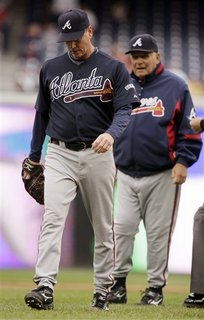 There was a palpable excitement when the Braves reported to Spring Training this season. The return of Tom Glavine gave Atlanta a rotation that boasted four former 20-game winners. Unfortunately, Glavine, John Smoltz, Tim Hudson and Mike Hampton were unable to complete one full turn through the rotation at any point during the season.
Glavine
and Smoltz could not provide the vintage Cy Young magic of their pasts,
both falling to injury in April and combining for just 18 starts
between them. When Hampton tore a pectoral muscle just prior to his
first start of the season, Atlanta found themselves operating without
three of their five regular starters. Hudson was not far behind. Those
losses would prove to be crippling to Atlanta’s play-off hopes.
The
rotation could have been viewed as a complete blackhole by the end of
July, were it not for the sparkling work of rookie right-hander Jair Jurrjens.
Acquired in a trade from the Detroit Tigers, Jurrjens finished his
first full season in the majors 13-10 with 3.68 ERA in 31 starts. Not
bad for a guy who was battling for the fifth spot in the rotation in
Grapefruit League play.
Hampton would eventually make it back,
returning in late July – just as Hudson’s season was being cut short by
Tommy John surgery. Settling in after a few rocky outings, Hampton
contributed solid work and quality innings over the season’s final
months. It was the first work for the left-hander since August of 2005.
suffered a shoulder injury and was shelled in seven starts before a
demotion to Richmond. Atlanta did see some quality work from Jorge Campillo, who gave the club 25 much needed starts and proved to be the only capable fill-in.
The Braves bullpen performed admirably in the face of overuse and injuries. Projected closer Rafael Soriano was a non-factor for much of the season with a mysterious elbow ailment. A success story in 2007, Peter Moylan was out by mid-April with Tommy John surgery of his own. Mike Gonzalez returned midway through the season to assume the closer’s role and re-established himself as a late inning force. Will Ohman, Jeff Bennett and Blaine Boyer provided the majority of the middle relief work, all making more than 70 appearances.
When it came to the offensive side, it would have been a good pre-season indicator to know that Chipper Jones
was going to win the NL batting title. As Chipper goes, so goes the
Braves line-up. However, poor indicators would have been to reveal that
Jeff Francoeur would regress to the point of being banished to the minor leagues and Mark Teixeira would be traded away prior to the July deadline.
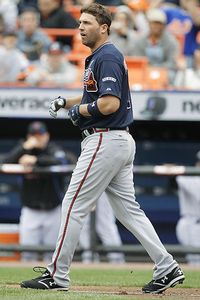 Francoeur’s
struggles were just a microcosm of the Braves season. His average
dropped 54 points to .239, home runs fell from 19 down to 11 and RBI
plummeted from 105 to 71 as compared to 2007’s numbers. The quick
decline have put contract extension talks on hold and put Francoeur’s
young star status in question.
Lost at the plate, Francoeur was
sent to Double A Mississippi in hopes it would jump start his bat.
Problems arose from the demotion, as Francoeur voiced his disapproval
to several media outlets in the days that followed. It made little
matter, because the trip down only lasted for three games. Francoeur
was back to his regularly scheduled struggles.
With Teixeira
traded to the Angels and Francoeur trying to find himself, the Braves
lineup hinged on the health of Jones and the production of catcher Brian McCann, who earned his third consecutive All-Star appearance.
McCann
batted .301 with 42 doubles and a club-leading 23 homers and 87 RBI.
His strong work may have been one of the only factors that kept the
Braves line-up from coming apart at the seams. I would rattle off a few
more statistical accomplishments of other members of the supporting
cast, but Jones and McCann fill the star character roles nicely for this end-of-year
exercise.
Pressing through a variety of injuries for the fifth season in a row,
Jones average climbed for the fifth campaign as well. Jones grabbed the
batting crown he had just missed in 2007, hitting .364 and belted his
400th homer to boot. That wasn’t the only time the number 400 and Jones
would be mentioned in the same sentence last season. Flirting with a
.400 average through most of June was hardly what most teams expect
from their 36-year old third baseman, but it seems Jones is simply
getting better with age.
Though the season was a 72-90
disaster, a record which was a reversal of what many predicted the
Braves to finish with at worst, there was hope that resonated through
the off-season. General manager Frank Wren came into the winter
with more than $40 million to work with in re-tuning the
rotation and adding a power-hitting left fielder.
Trade talks for Jake Peavy fizzled, as did subsequent attempts to sign free-agent starter A.J. Burnett. Despite this, Wren was able to strike a deal with the White Sox to bring middle of the rotation stalwart, Javier Vazquez, into the fray. His track record of durability was something Atlanta was without in 2008.
Many
have deemed the off-season a complete disappointment, with no bigger
exclamation point than that of the negotiations that turned into a big
game of Deal or No Deal with Rafael Furcal. What ever
happened, intent to sign or not, the Braves came up short in yet
another off-season pursuit. The pains of those dealings may carry on
for years to come, as the Braves have vowed to never do business with
the Wasserman Media Group again.
Now
that 2008 has mercifully come to a close, there is reason to hope that
the next two months will see Wren make improvements to the club for
2009. It may not be a year of contention and World Series hopes, but
with top prospects remaining in the system rather than heading to San
Diego, the Braves could return to their play-off ways by resuming the
tradition of cranking out young talent and promptly supplementing them
with the right veterans.
Here’s to 2009!
Till then,
G-Mc
Hey Fookie, don’t forget to RSVP…
If you thought the Jake Peavy saga was enough to sour the Atlanta off-season… And if you thought it was frustrating when A.J. Burnett chose the Yankees over the Braves… then you must have loved the drama that unfolded when the Braves were scorned in their pursuit of free-agent shortstop Rafael Furcal.
Monday morning, it was the Oakland Athletics running out in front of the pack with a four-year offer for Fucal’s services. There was a mystery team in the running, with the Kansas City Royals, Toronto Blue Jays and Los Angeles Dodgers all believed to be interested to varying degrees. That msystery team, as we now know, turned out to be the Atlanta Braves, who offered Furcal a three-year deal worth a reported $30 million and included a vesting option for a fourth season.
Everything seemed to be beautiful for a fleeting couple of hours if you’re into the homecoming story of Atlanta’s not-so-long-lost lead-off man. Frank Wren and the Braves front office believed a deal was verbally agreed to and went as far as to schedule a flight and physical for Wednesday. As reports trickled out, it turned out to be news to Dodgers GM Ned Colletti, who stated that his club was still in negotiations to retain Furcal. That is where we come off the tracks.
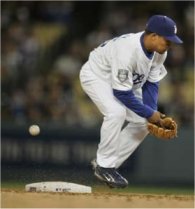 This story has twisted and turned and finally landed in the completely bizarre. Furcal’s Atlanta-based agent, Paul Kinzer, managed to thoroughly upset the apple-cart as it comes to the Braves front office. Atlanta believes that Kinzer took a signed term sheet (a binding agreement that would have put into motion a full contract following the physical) and shopped it openly to the Dodgers. Is it any coincidence that the Dodgers jumped from luke-warm interest (having made it clear that a 2-year deal was all they were interested in) to making a 3-year deal with a fourth year vesting option for… $30 million?
That raised a few eyebrows and more than a few red flags in my book. The fact that the Braves say they were lead to believe that they had an verbal agreement with Kinzer is hard to comprehend. How could they think they had a deal? How do you misunderstand a player agreeing to a deal in principle? I still don’t know how each side can state so fervently that they are in the right. Somebody is lying here folks. And I’m not even going to get into the debate regarding a position switch that may have been a deciding factor working against the Braves.
Personally, I don’t mind Furcal returning to the Dodgers. His major back surgery is not something that would lead me to believe he is fully recovered after just one week in late September and a handful of post-season games. Back injuries are tricky, and the Braves may have dodged a bullet (much-pun intended) by allowing the Dodgers to step up and “steal” Furcal away for a multi-year deal.
Wren and Braves President John Schuerholz have gone on the record as calling the moves made by Furcal’s agents “dispicable” and have stated they will never do business with the Wasserman Media Group again. Who knows if cooler heads will eventually prevail, but this thing has turned into a full scale fued.
The Braves have work to do, most notably, they need to acquire a front of the rotation starter and one more hitter to solidifty the rotation and the line-up. The free-agent pool offers a few options but it seems logical that one of these needs will be filled by a trade. Could it possibly be Jake Peavy after all this time?
Things are slow in Bravesland, but there’s still time on the clock for Wren to make it happen.
Till next time,
G-Mc
Yankees strike again, sign A.J. Burnett…
Well, I will say this for the free-spending kingpins of sports in the
free world: When they want somebody, they go out and get them. The New
York Yankees made another bold move to rebuild their rotation, agreeing to a 5-year $82 million contract with righty starter A.J. Burnett on Friday.
This means the Yankees have spent about a quarter of a billion dollars on starting pitching in less that 72-hours. That’s right, billion.
And you thought we were in a recession? Given, they cleared some
salaries (Jason Giambi, Mike Mussina, Andy Pettitte, Carl Pavano, Bobby
Abreu and Kyle Farnsworth), but that is still more spending that any
other club in baseball could possibly imagine. And it comes roughly
one-year after giving Alex Rodriguez a contract that will be worth over
another quarter of a billion (that’s $250,000,000 for those needing
another illustration of the dynamic we’re talking) by the time it’s
said and done.
Now Atlanta and general manager Frank Wren will
have to find a plan B. Whatever that may be is anyone’s guess, but I
would say it starts with the second tier free agent starters – lead by
left-hander Randy Wolf et al. Perhaps the Braves seek a shorter term
agreement for much less overall money with Ben Sheets, who is the only
real power pitcher left in the free-agent market. Let me go ahead and
say, I don’t think this is going to do anything to revive the very dead
Jake Peavy to Atlanta talks.
But now soon-to-be 32-year old A.J.
Burnett,
the same pitcher who has won more than 12 games only once
(last season) and the same pitcher who has pitched 200+ innings on just
three occassions, is going to be raking an average yearly salary of
$16.5
million for the next five seasons in the Bronx. His history of injury
doesn’t swallow like a bitter pill in New York, since they are the only
team in baseball that could afford to
lose him for a significant amount of time and feel little-to-no effects
on their October aspirations. They can simply buy a new one if he
breaks down, again.
This signing allows the Braves to save what
I believe will be a tremendous amount of money on an arm that already
comes with more than a few red flags attached. The trade market is
still an option, even if Peavy is not the answer. Atlanta lost the
ability to deal Yunel Escobar when Brent Lillibridge was dealt to the
White Sox in the Javier Vazquez deal. There are still other possibilities though, many of which have proven to be off the radar when it comes to the Braves.
So
the Braves went to
Las Vegas and essentially left the table with nothing to show for it,
having been unable to get their ace in Burnett and the power hitting
outfielder they were seeking. But there could be some bargains out
there if the markets
don’t develope for some of the free agents still lurking. The Braves
came into the off-season with more
money to spend than perhaps any other time in the club’s history and
they may be running out of priority players to spend it on.
In other news:
Atlanta non-tendered left-hander Chuck James
on Friday, making him a free-agent. James, 27, went 11-4 as a rookie in
2006 and 11-10 in 2007 before injuries and ineffectiveness put his
career with the Braves in question. Shoulder surgery performed in
September is expected keep James out for most of 2009. Last season,
James went just 2-5 with a 9.10 ERA in seven starts and allowed 10
homers in just 29.2 innings of work. James was sidelined for much of
spring training and spent the majority of last season in Triple-A
Richmond, where he went 5-5 with a 2.92 ERA in 15 starts.
Till next time
G-Mc
Winter Meetings: Day 4
I’d like an official count on the number of articles and blog entries posted about the “inevitable” trade of Jake Peavy to the Chicago Cubs. Now that deals is reported dead. Congratulations, Kevin Towers, you have completely ruined what should have been a textbook exercise in trading a much sought after star pitcher for some promising young talent as you rebuild an organization. More words were spilt over that debacle than almost any of the deals that actually came to pass at these meetings. And it may not be over yet.
As all the execs and agents boarded a plane and headed back to their respective cities, some departed with big needs filled while others went home empty handed.
Day 4: Recap — Coming Soon.
Till then,
G-Mc
I’ll trade you, but no take-backs!
As those that have followed the Braves rise to the top and subsequent slide back to the middle of the pack over the past two decades, one would notice that many of the key acquisitions during this time have come via the trade. It is a part of baseball that garners anticipation, excitement and sometimes disappointment for an organization and its fans.
I thought it would be fun to look at some of my favorite Braves trades, and some of my not-so-favorites, because we may have some trading fun to talk about here in the near future. I always like to hear the bad news first, so I can enjoy the good news a littler more… or at least temper my expectations. Here goes:
Top 5 Least Favorite Braves Trades:
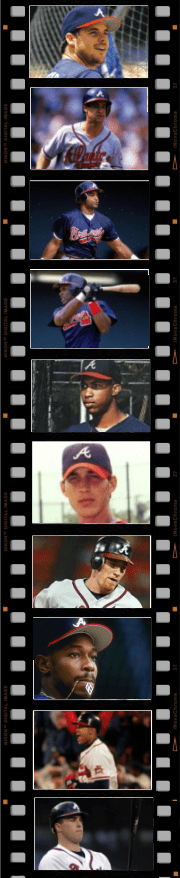 5. Ryan Klesko, Bret Boone & Jason Shiell to the San Diego Padres in exchange for Reggie Sanders, Quilvio Veras & Wally Joyner
Sanders was utterly terrible in his one season with the Braves while Veras tore an ACL and never appeared in the majors again after Atlanta. Despite there being no way to know these things would happen, Klesko, just 28 at the time, was a part of three World Series team and a product of the system. Boone had been the big off-season acquisition just one season earlier, so why trade these central pieces coming off a World Series appearance?
4. Jermaine Dye & Jamie Walker to the Kansas City Royals for Michael Tucker & Keith Lockhart
Here’s one where you can just say,”what if?” What if the Braves had held on to Jermaine Dye? Would he be the same player he became in Kansas City after some struggles? He’d more than likely have contributed at least as much as Tucker (the 10th overall pick in the ’92 draft) did in his two season with Atlanta. Lockhart proved to have the most staying power, lasting six seasons as a chief reserve and pinch-hitter. Hardly an even up swap for Dye and his 286 homers since 1997.
3. Adam Wainwright and Ray King to the St. Louis Cardinals for J.D. Drew and Eli Marrero
This is one reason the Braves find themselves looking for two front-line starting pitchers this off-season. J.D. Drew has moved on to greener pastures twice since having a career year for Atlanta in 2004. And I’m just going to say it now, Drew was not the second coming of Mickey Mantle. All Wainwright has done is prove the scouts that signed him right, developing into a staff ace by the age of 25. Too bad he doing so for the St. Louis Cardinals.
2. David Justice and Marquis Grissom to the Cleveland Indians for Kenny Lofton and Alan Embree
This is the ultimate in head-shakers. I couldn’t fathom the logic as a teenager and I still struggle to find anyone who would do this deal. Granted, Lofton was the ultimate lead-off hitter in 1997 and not the rent-a-player of the past seven or eight years, but still. Justice, who’s homer gave the Braves their lone World Series title of the 90s, was coming off an injury-plagued season but was still a potent middle of the order threat. Grissom was a consummate professional and still, in my opinion, every bit the center fielder Lofton ever was… and then some. To make matters worse, all three men would be playing in the same outfield in 1998… when Lofton signed a free-agent contract with Cleveland. Ouch. Atlanta did get 86 appearances out of Embree though. Heck of a silver lining.
1. Jarrod Saltalamacchia, Elvis Andrus, Matt Harrison, Beau Jones and Neftali Feliz to the Texas Rangers for Mark Teixeira and Ron Mahay
We have not even seen this trade bear fruit for the Texas Rangers, but it may be the deal that just keeps on getting worse for Atlanta. Teixeira was dealt away for Casey Kotchman and Stephen Marek almost a year to the day later. Would you do that prospect buffet deal for Kotchman? Me neither. Of all the deals I’ve covered here, this is a trade that simply should have never been made. Teixeira turned down an 8-year $140 million extension from the Rangers and I would have to say that common sense logic would dictate the Braves would have to pony-up even more to keep him. Mahay bounced to Kansas City for a richer deal than the Braves wanted to give him, so the Braves really came out of this deal having seriously depleted their rich farm system for a calender year of Teixeira and 30 appearances from a 36-year old left-hander.
In Closing…
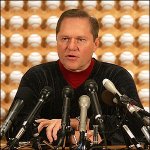 The Braves may not have known that Teixeira had already turned down that extension, but this trade was unable to push Atlanta in the play-offs. Maybe it was just all the poor luck of injuries this season that forced Frank Wren‘s hand when it came to trading Teixeira. Maybe it was Scott Boras and his hope of a $200 million pay-day for his client that forced the deal. If it underscores anything, it is that there are no promises in the game in this day and age. Even a player who spent his college years in Atlanta wants what he has coming. That’s why Boras claims a nice finder’s fee for that big contract Tex has coming.
So who is ready for a big trade this off-season?
Up next, my Top-5 Favorite Braves trades of the past 20 years.
Till then,
G-Mc
 Changing Speeds