Braves rotation primed for big season

Photo Credit: Scott Cunningham/ Getty Images

Photo Credit: Scott Cunningham/ Getty Images

If pitching wins championships, then the Atlanta Braves have the arms to lay the foundation for success in 2013.

There is a good mix of old and new in the starting rotation. Some already have impressive resumes, while others have something to prove this season.

The National League East could prove to be a two team race as it was in 2012. The Braves will rely heavily on their starting staff in order to overcome the Washington Nationals and bring Atlanta its first division title since 2005.

Each of these men will play an integral part in the Braves’ quest for October.

Photo Credit: Scott Cunningham/Getty Images

Photo Credit: Scott Cunningham/Getty Images

Tim Hudson is the veteran anchor of this rotation. He enters his 15th season in the big leagues and ninth with the Braves.

Hudson, 37, stands just three wins shy of 200 for his career and has led the Atlanta staff in victories five times, including each of the last three seasons.

Since the Oakland Athletics opted to break up the famed “Big Three” of Barry Zito, Mark Mulder and Hudson after 2004, it has been the Atlanta right-hander who has yielded the most consistent results. His .654 career winning percentage ranks fourth best among active hurlers with at least 100 decisions.

The Georgia native, who played his college ball at Auburn University, was given the chance to pitch for the team he grew up watching when he was traded from Oakland to Atlanta on December 16, 2004.

Hudson’s tenure in Atlanta has been productive, something he discussed with Mark Bowman of MLB.com this week:

“It’s been a while, and I feel like it’s been a good time here,” he said. “I feel like I’ve pulled my weight, or I wouldn’t have been here this long. Those were the expectations when I got here — to establish myself as a guy who could be here for a while.”

A tenacious competitor who utilizes a split-finger fastball, Hudson has historically done a great job of keeping the ball on the ground. He boasts a career mark of just 0.6 HR per 9 IP, which is fifth best among active pitchers with at least 100 decisions.

However, his 2012 ground ball to fly ball ratio of 1.71 dipped slightly below his career mark of 2.05, which led to a career-low nine double plays being turned behind him.

Atlanta exercised its $9 million team option on Hudson last October, a relative bargain for a proven 15-game winner in today’s market. He will need to get back to his ground ball ways in order to help the Braves make a run in the postseason.

Photo Credit: Mike Ehrmann/Getty Images

Photo Credit: Mike Ehrmann/Getty Images

Kris Medlen was perhaps the most dominant starter in Major League Baseball over the final two months of 2012. His ascension from long man to staff ace was one of Atlanta’s major second half storylines.

The 27-year-old enters the spring with his spot in the rotation already sewn up. Medlen’s incredible ride through the final months of 2012 proved he was more than ready for the responsibility of taking his turn every fifth day.

One tends to attract quite a bit of attention by going 9-0 with a 0.97 ERA over a 12 start stretch, especially when it comes to close out the season. That fine work earned Medlen NL Pitcher of the Month honors in August and September.

Opponents batted just .191 against him in his 12 starting assignments last season. Medlen’s superb control and nasty change-up had hitters shaking their collective heads according to ESPN’s Mark Simon.

Medlen was not shabby in 38 relief outings prior to replacing Jair Jurrjens the rotation on July 29. He finished 2012 with a 1.57 ERA in 138 IP across 50 total appearances, falling 24 innings shy of qualifying for the ERA title.

Perhaps the most staggering statistic was the run of success the Braves enjoyed when Medlen started a game. Dating back to 2010, Atlanta won 23 consecutive games started by Medlen before suffering the Wild Card loss to St. Louis last October.

Following the righty’s final regular season start, teammate Chipper Jones summed up Medlen’s value to MLB.com‘s Mark Bowman:

“He’s developed himself into the ace of our staff,” Jones said. “We know that if we go out there and give him three or four runs, the game is basically over. We all knew he was capable of that. He just needed to get healthy and be given the opportunity. He was very valuable to our ballclub out there in the ‘pen, but I think you see he’s a little more valuable to us in the starting rotation.”

Atlanta entered last season with Medlen as somewhat of a luxury arm in the bullpen, but things are very different in 2013. His mettle will be further tested over the course of a full season in the rotation.

The Braves are counting on Medlen to provide an encore performance this year.

Photo Credit: Kevin C. Cox/Getty Images

Photo Credit: Kevin C. Cox/Getty Images

It was a tale of two seasons for left-hander Mike Minor in 2012. His great second half erased the memories of early struggles and rewarded the Braves for sticking with him.

Minor was 4-6 with a 6.26 ERA after 16 starts in the season’s first half. He had surrendered 19 home runs and walked 40 batters in 92 innings to that point, but a different Minor appeared after the All-Star Break.

The lefty pitched with much more precision in the second half, cutting his walks down to just 16 over his final 14 starts. Keeping the ball in the park was the other area Minor needed to improve on. He passed that test as well, allowing just seven home runs over that stretch.

What a difference those two things made. Minor turned in a 2.16 ERA in 87 1/3 innings after the break. His second half record was just 6-4, but the Braves offense scored two or fewer runs in eight of Minor’s final 14 starts.

According to Jay Clemons of Fox Sports South, the Atlanta brass was expecting Minor to step up last season:

“We felt, when we left spring training last year, that Mike had turned the corner in maturity,” said Braves general manager Frank Wren. “He got off to a great start in the first month and then had two months of growing pains, before finally figuring it out the rest of the year. We look for Mike to build off what he learned from last year.”

The final three months of the season were proof that the Braves not only gauged his potential properly in the first round of the 2009 draft, but also in spring training.

ESPN’s David Schoenfield believes Minor’s improved location, especially with the change-up to right-hand batters, was the key to his second half turnaround.

While his work may have been in the shadow of Medlen down the stretch, Minor established himself as a major part of the rotation.

More of the same will be asked in 2013.

Photo Credit: Ronald C. Modra/Sports Imagery/Getty Images

Photo Credit: Ronald C. Modra/Sports Imagery/Getty Images

Like Minor, fellow southpaw Paul Maholm is a former first round pick. That is more or less where the similarities end between the two.

Maholm, 30, spent the bulk of his career with the Pittsburgh Pirates before signing as a free agent with the Chicago Cubs in January of 2012. His stay in Chicago was brief, but Maholm did enough to entice the Braves to add him to their starting staff last July.

Atlanta acquired Maholm to bolster the rotation and help cope with the loss of Brandon Beachy to season-ending elbow surgery.

Maholm enjoyed the best season of his career between Chicago and Atlanta. He set career-highs with 13 wins and 140 strikeouts, while his 3.67 ERA was just a fraction off his previous best set in 2011.

The lefty also came with an palatable $6.5 million team option which Atlanta exercised in October.

Every staff needs a veteran pitcher who can supply innings. Maholm is that man for the Braves, averaging 30 starts and 184 innings per season since 2006.

Maholm provided stability to the rotation in his 11 starts last season and will be expected to do so again.

Paired with Minor, Maholm gives Atlanta two solid lefties to balance the starting staff.

Photo Credit: Christian Petersen/Getty Images

Photo Credit: Christian Petersen/Getty Images

Given Beachy’s injury, opportunity is once again knocking at the door of highly regarded right-hander Julio Teheran.

One look at the Braves depth chart proves it.

Baseball America has the ranked Teheran among the top prospects in the game in 2011 and 2012. This year marks the third straight season that he tops the publication’s list of Braves prospects.

With his name appearing with the likes of Bryce Harper, Mike Trout and Matt Moore, the expectations for Teheran’s success were built in. He got a taste of the big leagues in 2011 after finishing with an impressive 15-3 record and a 2.55 ERA in 144 2/3 innings of work at Triple-A Gwinnett.

The stage was set, but the spring of 2012 was nothing short of disastrous for Teheran. He struggled mightily and never got on track after being sent back to Triple-A. His final numbers there included a 7-9 record with a 5.08 ERA in 131 IP.

More disturbing was the spike in the number of home runs allowed by the 21-year-old. He served up nine homers in just five appearances last spring, including six in one outing. His Grapefruit League struggles carried over to his International League performance, where he allowed 18 more long balls in 26 starts with Gwinnett.

Keep in mind, Teheran had given up just 20 total home runs in his first 383 2/3 professional innings.

Coming off a solid winter-ball showing in the Dominican Republic, Teheran spoke with David O’Brien of the Atlanta Journal-Constitution after reporting to camp:

“I feel like I have more confidence,” said Teheran, who allowed just two hits in 16-2/3 scoreless innings over his final three winter-ball starts, to finish 2-1 with a 3.23 ERA in seven starts for Licey. “I know I have to work hard to be the fifth starter, but in my mind, just work hard and I’ll be there.”

With Randall Delgado now in Arizona, Teheran is the favorite to land the fifth starter spot. There is always the possibility that a dark horse candidate may emerge to challenge him. Lefty Sean Gilmartin will get a look, but the 2011 first round pick has just seven starts above Double-A.

This could be a make or break season for the talented but as yet unproven Teheran.

Photo Credit: Daniel Shirey/Getty Images

Photo Credit: Daniel Shirey/Getty Images

Beachy held a major league-leading 2.00 ERA through 13 starts before he tore the ulnar collateral ligament in his right elbow last June. It was a big blow to the Braves staff, but helped open the door for Medlen to eventually join the rotation.

Despite the fact that he may not be ready to pitch until mid-season, Beachy still figures heavily into the Atlanta rotation. His rehab from Tommy John surgery is progressing, but there are still hurdles to clear before Beachy is ready to return.

In a 2011 article, Will Carroll of Sports Illustrated wrote that the typical recovery time from Tommy John surgery is 9-12 months. Beachy reported along with all the other Atlanta pitchers this week, but is still unable to throw off the mound.

The righty updated David O’Brien of the Atlanta Journal-Constitution on the timetable for taking the mound again:

“I’m not going to get hung up on an actual date,” he said, “because I haven’t even been on a mound yet. And I don’t know how it’s going to respond to the build-up. I’m just excited to get on the mound.”

Over parts of three big league seasons, the 26-year-old Beachy is 12-10 with a 3.07 ERA. He is without question the biggest strikeout pitcher on the Atlanta staff, piling up 252 K’s in 237 2/3 career innings. That is fine work for a third baseman turned occasional closer who went undrafted out of Indiana Wesleyan University.

Even without Beachy, the rotation has the depth and the talent to keep Atlanta in contention. There is a mix of experience and potential to go along with a balance of righties and lefties. It is a formidable group that will play a big part if the Braves are to make an extended run through October.

NL East: What to expect in 2013

East_Composite

Though the offseason still has a few days remaining before pitchers and catchers descend on Florida and Arizona, most teams have already completed the majority of their winter shopping. Save a couple of key free agents who are still searching for work, rosters have been shaped for what should be an interesting season in the National League East.

In 2012, the Washington Nationals announced their arrival with a division title. The Atlanta Braves waved goodbye to franchise icon Chipper Jones after a disappointing Wild Card loss, while the perennial powerhouse Philadelphia Phillies were beset by injuries. It was a frustrating season for the New York Mets, who fizzled in the second half. Down in Miami, the Marlins underwent a baffling and well chronicled identity crisis of epic proportions.

While the balance of power may not be shifting all that much, it is time to look at what to expect from the NL East in 2013.

ATLANTA BRAVES
The Braves went into the winter on the most disappointing of notes. A Wild Card loss to the St. Louis Cardinals stung on multiple levels, and put a halt to Chipper Jones’ magical retirement tour. GM Frank Wren did not spend his time dwelling on losses, and instead has positioned his club for big 2013 season thanks to an offseason packed with major moves.

Offseason Grade (A): Signed B.J. Upton. Traded Martin Prado and prospects for Justin Upton. Traded Tommy Hanson for Jordan Walden. Exercised team options on Tim Hudson, Paul Maholm and Brian McCann. Re-signed Reed Johnson. Signed Gerald Laird. Non-tendered Jair Jurrjens and Peter Moylan.

What they have: The Braves have a starting rotation that contains the grit and guile of proven veterans the pure stuff and potential of youthful hurlers. Hudson is the most battle tested, while Kris Medlen and Mike Minor flash the most promise. Maholm should capably hold down the fourth spot in the rotation, but top prospect Julio Teheran needs to return to his pre-2012 form at the back end. Brandon Beachy should be returning around the All-Star break from Tommy John surgery as well. Walden, an All-Star for the Angels in 2011, joins the trinity of Eric O’Flaherty, Jonny Venters and Craig Kimbrel to establish an incredible bullpen. On the offensive side of things, Atlanta’s lineup is much more righty-lefty balanced than in years past with plenty of run producing potential. However, for all the power they boast, Braves hitters will rack up quite a few strikeouts this season.

What they need: Big production from the young and talented outfield is an absolute must. B.J. and Justin Upton did not come cheap, and will be expected to play at a high level on both sides of the ball. Their contributions will complement the play of Jason Heyward, while all three men seek to prove themselves as the best outfield in the game. Atlanta also needs steady results from the third base position with Jones’ retirement and Prado’s departure. That will be tasked to Chris Johnson and Juan Francisco. A healthy McCann and a resurgent Dan Uggla could make this the most powerful lineup in the National League. But this game is not played on paper.

What to expect (2nd Place): The power potential of the lineup is off the charts. The rotation is strong, and the bullpen is stronger still. Atlanta won 94 games last season and has taken considerable steps to get better. If any team in the division has the pieces to unseat the Nationals, it is the Braves.

MIAMI MARLINS
The Marlins are a study in what not to do with the public image of a sports team. They completely threw in the towel on contending for the division crown not even one year after spending big money on player acquisitions and a new stadium. That being said, they have managed to stockpile an impressive amount of young, talented and controllable players for the foreseeable future. The jury remains out.

Offseason Grade (C+): It is not as simple as a letter grade with the Marlins, because nothing is simple with this team. Only time will tell when assessing the long term return from all the trades.

Traded Jose Reyes, Josh Johnson, Mark Buehrle, Emilio Bonifacio and John Buck to Toronto. Traded Heath Bell to Arizona. Traded Yunel Escobar to Tampa Bay. Fired manager Ozzie Guillen.

Miami hired Mike Redmond as its new manager. To fill the numerous player voids, the Marlins opted to sign a slew of veteran players to short term or minor league deals. Those include pitchers Jon Rauch, Chad Qualls, John Maine, and Kevin Slowey, outfielders Juan Pierre and Austin Kearns, as well as infielders Placido Polanco, Kevin Kouzmanoff and utility man Chone Figgins.

What they have: Miami held onto homegrown slugger Giancarlo Stanton, while it compiled a fascinating stock portfolio of young talent. As a manager, Redmond is a sharp baseball mind who has been working with young players in the Toronto system and will be a stark departure from Guillen. A crowded camp gives Remond more than a few options to choose from as the Marlins attempt to put the pieces back together following a chaotic 2012 season.

What they need: The Marlins could definitely benefit from some veteran reinforcements for the rotation and the bullpen. Some of the players signed over the winter could fit the bill, but many of them are on the comeback trail or simply far removed from their prime. There are plenty of prospects gleaned from other organizations through multiple trades. Some will break camp with the Marlins, while others are knocking on the door. The Marlins also have several high ceiling prospects ascending through the system. Among those are outfielder Christian Yelich and pitcher Jose Fernandez.

What to expect (5th Place): It is doubtful that this season’s Marlins will do much more in the win column than their 2012 predecessors. The unexpected rebuilding process will create challenges for the club when it comes to drawing crowds to its state of the art ballpark as well. However, the youth movement from all the trades made over the past eight months could bear some fruit this year.

NEW YORK METS
The 2012 Mets were trending in the right direction over the first three months, but a July collapse pushed them from a first place tie on June 3, to 24 games out by year’s end. R.A. Dickey’s Cy Young campaign, Johan Santana’s no-hitter, a healthy season from David Wright, and the debut of fireballer Matt Harvey were about the only highlights. They now find themselves in the midst of a rebuilding process.

Offseason Grade (B): Traded R.A. Dickey to Toronto. Released Jason Bay. Extended David Wright. Signed Shaun Marcum, Brandon Lyon, Scott Atchison, LaTroy Hawkins, and Pedro Feliciano.

What they have: Wright is now cemented as the face of the franchise after signing an eight-year extension. Even without Dickey, the starting rotation should still be a strength. Jon Niese is coming off a very respectable season. Add recently signed Marcum to Santana and Dillon Gee, then slot those arms in front of Harvey and New York has a nice starting five. Top prospect Zack Wheeler is also fast approaching, so there are reasons to be excited about the pitching staff. The offense is a different story, however. Wright and Ike Davis will provide some power at the infield corners, while the double play combo of Daniel Murphy and Ruben Tejada handle the bats relatively well. GM Sandy Alderson cobbled together what should be a serviceable bullpen.

What they need: There are several areas that could use marked improvement, none bigger than the outfield. The Mets appear to be stuck in neutral with Michael Bourn since they are in no hurry to sacrifice the #11 pick in this June’s draft. Any way you slice it, more production is needed from the outfield. Additionally, Davis needs to step forward as a true middle of the order threat. He started very slowly but ended the season with 32 home runs and 90 RBI’s thanks to a stronger second half. New York believes Davis is capable of more.

Stud catcher Travis D’ Arnaud was the big haul from Toronto in the Dickey trade and is a major piece of the puzzle. He could make the team with a strong showing this spring. Meanwhile, the oft-injured Santana threw the first no-hitter in franchise history on June 1, 2012, but did not seem to be the same after that. Though he may not be a true ace-type pitcher anymore, he could still be a 15-game winner in the big leagues if healthy.

What to expect (4th Place): There’s very little chance that the Mets will be contending for even a Wild Card spot this season, but the future is looking brighter.

PHILADELPHIA PHILLIES
Call it a combination of age and injury, but whatever it was did no favors to the Phillies last year. Losing key pieces in the lineup and pitching staff kept the club from ever enjoying any kind of consistent success. Philadelphia found themselves doing some selling at the trade deadline last season, and questions remain heading into the 2013 campaign.

Offseason Grade (C+): Traded for Michael Young. Traded for Ben Revere. Signed Delmon Young, John Lannan and Mike Adams.

What they have: This is a team comprised largely of proven winners. Jimmy Rollins, Chase Utley and Ryan Howard remain the core offensive pieces, while the rotation boasts Roy Halladay, Cliff Lee and Cole Hamels. Closer Jonathan Papelbon had his fair share of success in Boston before signing with Philadelphia prior to 2012. Trading for Michael Young gives Philadelphia a player who brings consistency at the plate and versatility in the field, though he will start at third base. Getting center fielder Ben Revere from Minnesota brings speed, defense and a top of the order type bat to offset last season’s trade of Shane Victorino.

What they need: Health is the key for the Phillies. In order to compete, Utley and Howard have to be in the lineup on a regular basis, and Halladay must be taking his turn every fifth day. The corner outfield spots are anything but certain. Philadelphia signed Delmon Young, and hope that he can be a full season regular in right field for the first time since 2007. Offseason ankle surgery could delay his season debut, however. A long awaited step forward by Dominic Brown would go a long way toward alleviating at least some of the problem. John Mayberry Jr. and Darin Ruf could see some time in the outfield as well. Even though Michael Young has established a reputation as a professional hitter, Philadelphia needs him to bounce back to pre-2012 form. Last year with Texas, Young collected his fewest hits and RBI’s in a season since 2002, and set a career-low with only eight home runs.

What to expect (3rd Place): Philadelphia’s 2012 woes were due in large part to injury. Even with Hamels, Lee and Halladay all pitching well, there are still quite a few lineup and run production questions that must be addressed. This group could get back around or above .500, but bypassing Washington and Atlanta to win the division and/or a wild card spot is a stretch.

WASHINGTON NATIONALS
The Nationals spent recent years building their team in hopes of jumping into the mix. Player development was key, but utilizing the free agent market effectively was of the utmost importance. Instead of simply dipping their toe in the pool, Washington went ahead and bought the entire property. Now they are set up to swim with the big fish in all of baseball for years to come.

Offseason Grade (A): Traded for Denard Span. Signed Dan Haren and Rafael Soriano. Re-signed Adam LaRoche. Traded Michael Morse to Seattle.

What they have: This is a talented team that seems destined for great things. The rotation of Stephen Strasburg, Gio Gonzalez, Jordan Zimmerman, Haren and Ross Detwiler will provide the foundation for contention. Signing Soriano to close games made the bullpen even better. The lineup has a balance of speed and power that is perhaps best exemplified by Bryce Harper, Ian Desmond, and to a lesser extent, Danny Espinosa. The veteran presence of Ryan Zimmerman, Adam LaRoche, Jayson Werth, Denard Span and Kurt Suzuki rounds out a batting order which should provide plenty of runs this season. Manager Davey Johnson is going to have an extremely talented team to defend the division title, but repeating is generally the tricky part.

What they need: It may be as simple as having a full season of Strasburg to put Washington deep into October. Shutting him down for the stretch run and playoffs in 2012 did not stop the club from clinching the East, but there is no doubt it impacted the team’s ability to advance beyond the NLDS. The postseason is the time of year when a team depends on its staff ace more than ever. A bullpen which was strong last year was made even better when Soriano signed over the winter, but the Nationals are counting on seeing the dominant Soriano who was a late inning force in 2010 and 2012 rather than the somewhat listless 2011 version. Though Washington does have some very capable closing candidates in house if he falters, the move to bring in Soriano was designed to make the late innings a steep task for opposing hitters. It was also a decision that did not come cheap.

What to expect (1st Place): Another good season in the Nation’s capitol seems to be in the making. The strength of pitching and talented lineup should allow Washington to maintain its status as the team to beat in the East.

Braves introduce newest Upton

Upton Jersey Presentation

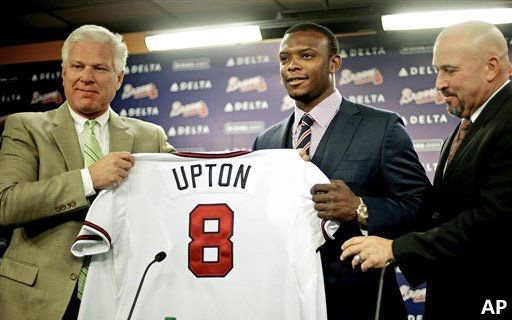
An excited Justin Upton rolled into Turner Field with brother B.J. and the rest of his family on Tuesday as the Atlanta Braves introduced the newest addition to its potent young outfield.

“The last few days have been kind of crazy,” said Upton. “It hasn’t really sunk in completely, and it won’t until you step on the field in spring training.”

Upton was living amidst speculation that he could be traded by the Arizona Diamondbacks for months. Numerous teams inquired, and an early January deal to the Seattle Mariners was ultimately vetoed by the young outfielder. For the native of Chesapeake, Virginia, this trade to Atlanta represented the perfect opportunity to begin the next chapter of his career.

Having the chance to play with his brother and be closer to his entire family is a dream scenario. One that the Upton brothers could not have foreseen would play out so favorably, or so soon.

“I didn’t think it would happen this year,” said the younger Upton. “You don’t get that lucky. But for us both to have that chance now, for that to actually happen, and for us to be on the same team, [it’s] tough to really put into words how it feels. We’re excited about it and looking forward to it.”

Their dream of playing together became a reality when the Braves and Diamondbacks agreed to a seven-player trade on January 24. Upton and Chris Johnson came to Atlanta in exchange for Martin Prado, Randall Delgado and three prospects.

Even before signing the elder brother, B.J., to a five-year free agent contract in late November, Braves general manager Frank Wren was intrigued to discover that Justin might be available.

“I don’t think it was realistic for us until probably 10 days ago,” remarked Wren on of the trade talks. “We inquired going back even before we had signed B.J., when we started hearing some rumblings around the general managers meetings that Justin would be a guy they would talk about. So we inquired at that time and kind of got pushed back with some of the names.”

Initially, Diamondbacks GM Kevin Towers was shopping for a young, major league ready shortstop and Wren was not interested in trading away Andrelton Simmons. Once Arizona pulled off a three-team deal that landed Didi Gregorius in part from the Cincinnati Reds, Arizona’s desire for Simmons was no longer a stumbling block.

“I think after that we started to settle in on some names and started building the deal as it turned out,” said Wren in regards to renewing negotiations following the nixed deal between Arizona and Seattle.

Bringing the Upton brothers to Atlanta generates an exciting dynamic for the team as it moves on from the Chipper Jones era. Specifically, combining the Uptons with Jason Heyward creates one of the finest outfields in baseball, a fact that is not lost on Justin.

“Everybody out there can move, [and] can cover some ground,” he said. “I think it’s special to have that kind of athleticism in the outfield.”

With the Uptons and Heyward all young and under team control for a minimum of three seasons, Braves fans can expect many special things to come.

Big trade unites Upton brothers in Atlanta

uptonstrade_AP

The trade speculation surrounding Justin Upton has been swirling for months. It all came to a head on Wednesday as the Braves and Diamondbacks agreed to a seven-player deal that will unite Justin with older brother B.J. in Atlanta.

Let’s start with the players changing addresses. Atlanta sent the versatile Martin Prado, as well as RHP Randall Delgado, shortstop Nick Ahmed, RHP Zeke Spruill and corner infielder Brandon Drury to Arizona in return for Justin Upton and third baseman Chris Johnson. Those are the pieces, so now it’s time to break this trade down.

Initial reaction…

The storyline was penned as the ink was drying on B.J.’s 5-year deal with the Braves back in November. What a dream scenario it would be if Arizona and Atlanta could find a way to unite the Upton brothers. The topic came up during the press conference and B.J. was obviously excited about the possibility. Now it has become a reality.

Atlanta added a young impact bat just months after Chipper Jones‘ retirement presented questions about how the lineup would cope with his loss. Prado is a free agent at the end of the season and the Braves could have found themselves in a similar scenario as this winter with Michael Bourn. That’s to say, a good but not great player, over 30, looking for max years and max dollars on the open market. That’s not a scenario where you want to feel your hand is being forced to retain the services of a player. Acquiring Johnson gives Atlanta a third base candidate with power potential who comes at a fraction of the price of extending Prado.

What they got…

Atlanta constructed the finest outfield in the National League by acquiring one the most talented young players in all of baseball. They now have three players who have 30-30 potential, play strong defense and are all 28 years of age or younger.

Upton, 25, finished 4th in the NL MVP voting in 2011 while taking home his first silver slugger. This is a former first overall pick who debuted in the big leagues at just 19 years old, is already a two-time All-Star and brings with him that “5-tool player” tag. His 2011 campaign (.289/.369/.529 with 31 homers, 88 RBI’s and 105 R’s) led many media types, talent evaluators, baseball execs and fans alike to believe that he could actually be the MVP as soon as 2012. That prediction may not have come to pass, but Upton’s talent and potential are still tantalizing.

Last year was a frustrating season on many levels for Upton and the Diamondbacks. Still, he turned in a .280/.355/.430 line while scoring a career-high 107 runs. On the flip side, his RBI total fell by 21 and he had 30 fewer extra-base hits in just nine fewer games than in 2011. While it was a step back in what many expected to be a break-out season, the Braves are still getting a phenomenal young talent who is entering the prime of his career. Putting him together with his brother will deliver both comfort and motivation that can be found in a good natured sibling rivalry.

The Braves parting with Prado in the deal meant third base became a top priority. Hence, the D-Backs added the 28-year old Johnson, who they acquired from the Astros last season, to the deal. He has power, and has shown the ability to hit for power and produce runs in parts for four big league seasons. Johnson’s run production totals (171 RBI’s & 121 R’s) are remarkably similar to those of Cardinals third baseman David Freese (177 RBI’s & 142 R’s).

Both debuted in 2009, but Johnson has more extra-base hits (114 XBH’s in 348 games) than Freese (93 XBH’s in 328 games). However, Freese does have two more homers (35) than Johnson (33) in 84 fewer plate appearances. While the two are certainly not carbon copies of one another, it does provide a decent measuring stick for production. Johnson will presumably compete for the starting job at third or serve as part of a platoon with the lefty hitting Juan Fransisco, who turned heads in winter ball after belting nine homers in 192 at-bats for Atlanta last year.

What they gave

We start with the obvious – Prado will be missed for a multitude of reasons. Many wondered aloud how/why the Braves could be going to arbitration with Prado over a $400,000 difference his request ($7.05 MM) and the team’s offer ($6.65 MM). Maybe that was a sign that Atlanta was silently shopping one of its most consistent hitters. Regardless, Prado did everything and more Atlanta has required of him since debuting in 2006. He hasn’t taken the mound, but he has played every position except for catcher.

Prado, who turns 30 on April 23, was an All-Star in 2010 and  has averaged a .294/.342/.436 line since playing his way into the everyday lineup in 2009. Those seasonal averages break down to 12 HR’s, 60 RBI’s and 78 runs scored per 138 games. He battled injury and inconsistency in 2011, only to bounce back and hit .301 while setting career bests in games played (156), hits (186), doubles (42), walks (58) and on-base percentage (.359). Oh, and he played five positions in 2012. Factor in his gritty, competitive nature and popularity among teammates and fans alike and you have a player that any team in baseball would be happy to have. Our friends over at MLB Trade Rumors have already started compiling the links to prove it, since the Diamondbacks are apparently already working toward a deal to keep Prado in the desert for the foreseeable future.

Now for the prospects involved. Delgado, who turns 23 in two weeks, was ranked the #46 prospect in the game by Baseball America prior to 2012. He split time between Atlanta and Gwinnett last season and showed flashes of brilliance in 17 starts for the big club. Overall, Delgado has gone 5-10 with a 3.95 ERA in 25 games (24 starts) in Atlanta. Over 127.2 big league innings, he’s struck out 94 hitters against 56 walks while surrendering 13 homers. With a mid-90s fastball and quality secondary pitches, Delgado fanned 620 hitters in 582.1 minor league innings since signing as a 16-year-old out of Panama in 2006.

Ahmed, 23 on March 15, was a 2nd round selection in 2011 out of the University of Connecticut. He has a good build (6’3″-205 lbs) and plenty of speed. Baseball America rated Ahmed the #11 prospect and best defensive infielder in the Atlanta organization following 2012. He stole 40 bases in 50 attempts during his 130 games spent with High-A Lynchburg last season before playing in the Arizona Fall League. Ahmed found more success there, hitting .288/.361 /.452 with 10 RBI’s and 13 runs scored in 19 contests for the Phoenix Desert Dogs. The AJC’s Dave O’Brien had a great blog highlighting Ahmed’s winter ball performance.  There had been some speculation that the Braves could use Ahmed as part of a trade package, given the team’s refusal to part with Andrelton Simmons.

Spruill, 23, a high school arm nabbed in the 2nd round back in 2008, has been ranked among Baseball American’s Top 10 Braves prospects in three of the last four seasons. He’s had some growing pains – specifically a broken hand suffered after a poor outing in 2009 that led to even more struggles in a truncated 2010 campaign. With that squarely behind him, Spruill matured emotionally and on the mound. His numbers improved between Lynchburg and Double-A Mississippi in 2011 (3.19 ERA in 174.2 IP) and he was tabbed the “Best Control” pitcher in the system by Baseball America after the season. In 2012, Spruill returned to Double-A, where went just 9-11, but walked only 46 batters in 161.2 IP.

Drury, 21, was the last player confirmed to be heading to Arizona in the deal. He was a 13th round pick in 2010 and had some serious steam coming off a successful Appalachian League campaign with Danville in 2011 (.347 with 8 HR and 54 RBI in 63 games). After Baseball America named him the #10 Braves prospect going into 2012, Drury faltered mightily with Rome last year. He batted .229 in 123 games, connecting for just six homers. Neither his strikeout (73) nor his walk (20) totals were particularly high, and Drury did put together a better second half to check in as Baseball America’s #27 prospect in the organization.

What I like about it…

There you have a complete listing of all the players involved. I’m a firm believer that the Braves have added a young impact player – and get this – Upton won’t be bolting anytime soon. His contract over the next 3 years is $38.5 MM, which is less per year than agent Scott Boras was seeking for Bourn. There is no comparison between those two players, but from a financial perspective the Braves got the better man. Of course, you have to factor in the player cost of this trade as well. Atlanta needed to balance its lineup with more right-hand hitters, something general manager Frank Wren accomplished by acquiring the Uptons this winter. I also like the fact that the Braves have managed to set aside a little chunk of money to spend on further improvements this season. They could also utilize the money to sign some young core players to multi-year deals, something that has become more and more common in the game.

By seizing the opportunity to combine Justin and B.J. Upton with Jason Heyward, Atlanta has created an outfield that could rival or perhaps even edge out the Los Angeles Angels trio of Mike Trout, Josh Hamilton and Mark Trumbo. While the Braves aren’t concerned with comparing their outfield with anyone else, they are concerned with putting the best group of players on the field.

Atlanta needed to do something bold in order to close the gap between the Washington Nationals and the rest of the National League East. The outfield trio comprised of two Uptons and Heyward should produce both offensively and defensively. It seems to me that both teams could win this deal, especially if Arizona extends Prado and he continues his quality level of play. Not to mention what all the young talent can do to replenish and bolster the Arizona ranks.

What concerns me…

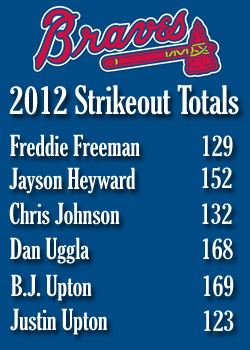
strikeout graphicLet’s go ahead and take a look at all those strikeouts the Braves now have in the lineup. This has been the topic du jour when it comes to the trade. Atlanta added two more players who fanned in excess of 120 times last season to the four players it already had who piled up at least 129 K’s in 2012. It’s not ideal from a traditional perspective, but the way the game is played has changed drastically over the past three decades. Strikeouts from hitters have become more acceptable. Shaking your head? Don’t believe me? Well, Adam Dunn was named the 2012 AL Comeback Player of the Year in a season that saw him bat just .204 and strike out 222 times. How does that happen? (Yes, that’s a rhetorical question.)

I went on a historical fact finding mission, looking over all baseball team statistics by the decade from 1900 to 2012. It wasn’t until the year 1960 that any MLB team combined to strike out over 1,000 times (Philadelphia Phillies with 1054). Teams’ K-totals escalated throughout the 60’s, topping 1,000 on numerous occasions until the mound was lowered in 1969. Then, from 1972 through 1982 only two teams in all of baseball struck out 1,000+ times. Team totals began to escalate again in the 1990’s.

To say that the way the game has changed would be a gross understatement.  Are you ready for the proof? No MLB team struck out fewer than 1,000 times in 2012. Even if the thought of strikeouts continues to frustrate fans, players and executives, those elevated punch-out totals have become more acceptable. That’s why I lean toward not taking Atlanta’s strikeout prone bunch to task here. Let’s wait and see what the numbers look like for situational hitting.

What to take away…

Time will tell for both sides. What can the Braves do with Upton on board? What will Prado and the group of young players do for the Diamondbacks? Obviously, I like the price and years of control Atlanta has with Upton more than what turned out to be a disastrous acquisition of Mark Teixeira in 2007. That deal is a case study on what can happen when you trade young players away and don’t get any sizable return for your investment. And it’s also a topic I don’t care to delve into any further.

Atlanta does not have a prototypical lead-off hitter, but they do have plenty of speed between their outfield trio. They also have a nice group of righty and lefty hitters to mix and match. I’d imagine Justin Upton will see most of his at-bats in the #3 spot in the order. The opportunity to lead off could be given to Simmons, followed by Heyward hitting second (though he might get a chance to lead off as well). Older brother B.J.’s days of hitting atop the lineup are likely behind him. I picture him slotting into the 5-spot, behind clean-up man Freddie Freeman.

But hey, these choices and more are manager Fredi Gonzalez‘ to make. And does he ever have some options.

Ross could be Braves’ wild card on Friday

Image

The Atlanta Braves need to win one game to continue their quest through the 2012 Postseason. That game comes on Friday against the St. Louis Cardinals at Turner Field and determines the National League’s true “Wild Card” under Major League Baseball’s new expanded playoffs.

On the surface, the decision to start backup catcher David Ross over All-Star stalwart Brian McCann seems unorthodox to say the least. It was certainly not a question of loyalty for manager Fredi Gonzalez, but with the Braves’ postseason aspirations tied to a single game, one cannot afford to simply play favorites.

Initially it was not a popular decision with McCann. How could it be? What player would not want to be in the lineup at a time like this?

It was a tough pill to swallow, but after taking the the news the way one would expect, McCann put his support squarely behind his teammate Ross by the time he spoke to MLB.com’s Mark Bowman on Thursday:

“I wish I was playing, but I’m not,” McCann said. “That’s it. Rossy has been playing unbelievable and I’m his biggest fan. He’s one of my best friends in the world and he’s going to play great.”

Offensively speaking…

This has been the worst of McCann’s seven full seasons in the majors. An ailing right shoulder has plagued him throughout a campaign in which he set career lows with a .230 AVG, .300 OBP, and .399 SLG. Based on McCann’s downward trend over the final two months of the season, Ross represents the best option for Gonzalez and the Braves in the one-game “win or go home” scenario.

Ross has spent four seasons with the Braves and has established himself as the best backup catcher in baseball. His powerful bat and veteran presence have been the perfect compliment for McCann when it was time for a day off. In his 577 at-bats with Atlanta – about a season’s worth of work for an everyday player – Ross has batted .269 with 24 homers and 94 RBI’s.

Despite McCann’s down year, it remains common practice for most managers to load their lineup with left-handed bats against a right-hander like St Louis starter Kyle Lohse. In that regard, this is a case of going against the book. It is also a move that Gonzalez believes will give Atlanta the best chance to win this game.

This season’s numbers support the decision there as well, with McCann batting .230 with 15 homers and 51 RBI’s in 84 games started by righties. Ross hit .260 with 4 home runs and 13 RBI’s  in his 28 games against right-handed starters.

Another – and perhaps more glaring – split statistic for each was performance at home this season. McCann connected for 11 of his 20 homers at Turner Field, but batted just .198 in 56 games there.  That low mark for McCann included a dreadful 2-for-49 skid to close out the home schedule. While his sample size may be much smaller, Ross batted a solid .260 with 4 HR’s and 13 RBI’s in 23 home contests.

The Medlen connection…

Offensive numbers are one thing, but there is more to consider when it comes to what Ross has to offer his club. Friday starter Kris Medlen will be pitching the biggest game of his young career. His season deserves a blog post of its own, but what is important to note here is that, while Medlen has shined with both men behind the plate, he has been at his best working with Ross.

Over 13 total appearances, Medlen sported a 0.81 ERA in 44-1/3 innings this year with Ross calling the signs. Perhaps more to the point was the success that the two men enjoyed as a battery in a trio of September starts. Two of those games rank among the best performances of the young right-hander’s career.

Medlen allowed one unearned run to Washington while setting a career-high with 12 strikeouts in a complete game effort on September 3. Two starts later, he eclipsed that mark by fanning 13 Miami hitters over seven innings of one-run ball. Medlen capped his season by winning his ninth consecutive decision, defeating New York on September 30.

When Medlen worked with Ross in September, he allowed just 1 ER (3 total) in 22 innings for a 0.41 ERA. The 31 strikeouts came against just two walks and at the staggering rate of 12.7 K/9 IP. Opponents batted just .121 in those three starts.

Any way you slice Medlen’s season, the numbers border on the absurd. McCann should be credited for his excellent handling of the staff, which included a 1.75 ERA in 92-2/3 innings pitched by Medlen during the regular season. The postseason, however, has proven itself to be a different monster entirely.

Looking solely at what has been working lately with the pairing of Medlen and Ross, there is simply too much chemistry to ignore. That is not a swipe at McCann. It is simply the circumstances that the Braves find themselves in.

A one-game playoff scenario.

What to take away…

All of those spits and statistics tell the story of why Fredi Gonzalez arrived at his decision to go with Ross over McCann. Plugging in a reserve catcher as skilled as Ross is a luxury that most if not every other team in baseball do not have.

Make no mistake about it, Atlanta will need McCann to regain some of his All-Star form in order to make a successful run toward a World Series championship. One can only imagine that McCann would be more than happy to oblige. After all, the games only get bigger from here.

We can throw a few more statistics and facts at the wall prior to the game.

Till then,

G-Mc

Catching up with Giancarlo Stanton

This post will be brief, but perhaps the first step in getting back to some Major League blogging once my minor league season comes to a close on September 2. I had the opportunity to talk with Miami Marlins outfielder Giancarlo Stanton about his rehab from right knee surgery, his path to the Majors and the 2012 Marlins.

Enjoy — G-Mc

The Curious Case of Albert Pujols’ Free Agency

You’ve probably heard by now that Albert Pujols is changing addresses. No matter what your opinion of the contract awarded to Pujols by the Los Angeles Angels of Anaheim – and there seems to already be one overwhelming consensus – this marks the end of era in St. Louis and the National League alike.

Pujols, who turns 32 prior to the 2012 season, got an incredible offer from the Angels in order to leave the St. Louis Cardinals on the heels of a World Series championship. In his 11-seasons, Pujols terrorized NL pitchers while putting together a Hall of Fame resume. The fact remains, he is not going to be getting any younger and his best days have probably already passed.

So, who exactly won and lost with this deal? It’s a little more complicated than money, statistics or age. In some ways, all of those things favor both the individual and the clubs involved. In other ways, those same things befuddle the mind when it comes to rational spending and/or decision making.

Right out of the chute, I am going to call this a WIN for the Cardinals – though they may not want to hear it. Not signing Pujols to a 10-year contract may end up being in the best interest of St. Louis. The staggering length of contract puts Pujols in his early 40’s by the time this deal has reached a conclusion. Are we to believe that he’ll be capable of playing the field at a high level on a regular basis while making an incredibly high salary and being essentially untradeable? Highly unlikely. A regular soapbox that I may jump on later states, “You cannot get caught up in simply paying for the past without reasonable regard for the future.”

The consensus as I interpreted it, believe this contract would have been a terrible decision for National League team. It’s certainly questionable for the American League club that landed him. By the way, not signing Pujols to a 10-year contract is also a WIN for the Marlins, who were likewise spurned in the pursuit of Albert’s services. All the same reasons I listed above would have applied to any NL suitor.

The very fact that the Angels will be able to utilize the designated hitter rule in the waning years of this contract makes it a WIN for the Angels. Of course, a healthy Pujols, which we have no reason to doubt at the outset, will make an obvious impact in the Angels lineup – and that’s the biggest WIN for L.A. They’ll be making more than a few extra bucks on season tickets, jerseys and other merchandise that Pujols’ signing generates as well. It’s not everyday that you acquire  “the best hitter in the game,” so Angels fans have plenty to be excited about.

On the other hand. St. Louis fans are obviously crushed by this turn of events. As team legend Ozzie Smith said Friday on MLB Network, there’s a lot to appreciate Pujols for in his time in St. Louis. The Cardinals got 11 great years, two World Series titles and 3 MVP’s from Pujols. He certainly won’t be Stan Musial, who was, is and always will be “The Man” in St. Louis. Could Pujols have eclipsed Musial? We’ll never know.

It’s a WIN for Pujols, who got the big money, long term contract that came with that coveted no-trade clause. He’ll be well compensated for 10-years on the playing field, and retained for an additional 10-years as a consultant to Angels owner Arte Moreno when his playing days are over. That was not readily apparent when the initial facts and figures of Pujols moving out to Anaheim were coming across the wire.

Speaking of money, here’s another tidbit I gleaned from MLB Network: Musial made roughly $1.26 million over his 22-year playing career (according to Baseball Reference).  Pujols will make that same sum every 2 1/2 weeks in his new deal. Times have most definitely changed.

I guess it’s time for me to point out the losses and/or losers in this deal. The Angels aren’t exactly winners simply because they can DH an aging Pujols in the twilight of his career. It will probably be around that time (2019-21) that Angels fans start wondering what exactly they are paying for. I’ll call that part a LOSS for the Angels in all likelyhood. He may be equally loved by Angels fans at that point. He may stay healthy and age gracefully. He may continue to be good, if not great at the plate. That certainly is a lot of money to be tied up in a lot of maybe’s.

The Cardinals get a LOSS for ever allowing their franchise figurehead to reach free agency to begin with. The fact that he was not re-signed at some point over the past two seasons was a strong indication that the two sides had a pretty serious difference of opinion on the money or the years… or both. Why Pujols should have be forced to settle for considerably less than the contract signed by Alex Rodriguez in December of 2007 is a valid point.

Rodriguez was roughly the same age when he signed a record 10-year $275 million extension with the Yankees. A-Rod is the only other player who’s been in a similar situation as Pujols. That is being perhaps the best in the game, just past his prime and looking for a long term contract to close out a legendary career. We’re seeing the declining numbers in New York for Rodriguez. Could that be a harbinger of things to come in Anaheim?

I’m going to go ahead and give the man himself a LOSS as well. That’s right, despite the years, the money and the no-trade clause all going his way, Albert Pujols lost out here too.  I’m not one for making the remark, “What’s a few million if you get to stay with the one club you’ve grown up with?” However, I would have to utter something along those lines in this case. If the years were there and the money was substantial, why would you walk away from your legacy and a city that adores you? It’s a valid question. And it’s one that will only be answered in time.

Did he make the right decision? That too will be answered in time.

Winter Meetings: Miami Marlins setting the tone

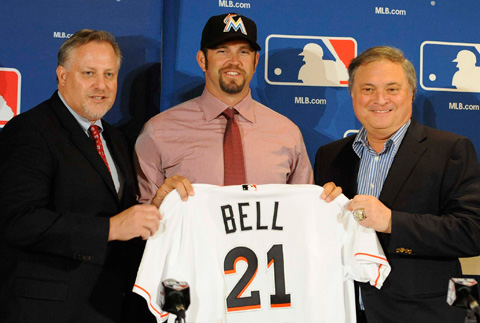
The Marlins introduced new closer Heath Bell on Monday at the Winter Meetings.

The Winter Meetings got under way in earnest on Monday, but the new look Miami Marlins weren’t waiting around for the baseball world to gather in Dallas. Instead, they were busy setting the tone for a franchise on the rise in the National League East.

A new ballpark, new manager, new uniforms, and some serious new acquisitions are all being set in place for 2012. And the Marlins may not be done spending yet.

Not by a long shot.

PHASE 1:

Prior to the meetings, Miami took an aggressive approach to begin filling voids via free agency. All-Star closer Heath Bell was the first piece of the puzzle. Bell, 34, inked a 3-year $27 million deal that includes a fourth year vesting option. The Marlins won’t have to wonder what they’re getting – or who they’re getting for that matter (Leo Nunez) – in Bell.

After replacing  Trevor Hoffman as San Diego’s closer in 2009, the hefty right-hander registered three consecutive 40+ save seasons (132 total) to go along with a composite 2.36 ERA in 202 1/3 innings. The NL hit just .219 against Bell, who was an All-Star each of the past three seasons while serving as the Padres stopper.

PHASE 2:

As if Bell didn’t send a message that the Marlins were interested in spending some money this offseason, their next big move was certainly an attention grabber. Already with one young superstar shortstop, the Marlins added a second by agreeing to a 6-year $106 million with Jose Reyes. Another aggressive negotiation that not only made Miami better, but it allowed them to weaken a divisional foe by plucking him from the rival New York Mets.

The deal is expected to be announced in Dallas before the meetings come to a close, as soon as Reyes completes a physical. While it does include a vesting option for a seventh year (worth $22 million), it’s interesting to note that a no-trade clause is not included in the deal.

Reyes, 28, is an exciting player to put at the top of the lineup. Whether he bats leadoff or in the two hole, the Marlins just got a premier run-scorer. While leading the NL with his .337 batting average, Reyes scored 101 runs in 126 games played in 2011. The unfortunate thing for Reyes has been his battle to stay on the field over the past three years. He has missed a combined 191 games during that stretch. When healthy, the four-time NL All-Star led the league in triples four times, stolen bases three times, and hits on one occasion.

The aforementioned other “young superstar shortstop” would be none other than Hanley Ramirez. The signing of Reyes means that the Marlins will be shifting Ramirez (soon-to-be 28-years-old) to another position, which most believe will be third base. Whether or not Ramirez is thrilled about putting his days as a shortstop behind him has been debated, but Reyes will be patrolling that spot for the foreseeable future. The signing of Reyes makes the Marlins better, and that is something Ramirez has probably realized.

Ramirez is coming off the worst season of his young career, batting just .243 and appearing in just 92 games, so he’ll be looking for a fresh start in more ways than one. Before you get caught up on that last statement, one fresh start that does not appear to be in line for Ramirez is via trade. All indications are that the Marlins will be holding on to the talented young infielder.

PHASE 3:

With two big pieces already on board, Miami is still actively pursuing the biggest names on the market. Albert Pujols has already received a 9-year offer and his agent, Dan Lozano, spent a very busy Monday meeting with Marlins brass to continue talks that could bring Pujols to South Beach. Imagine a lineup with Reyes, Ramirez and Pujols joining Mike Stanton and perhaps Gaby Sanchez and Logan Morrison to form some sort of new age “Murderers’ Row.”

I don’t think anyone needs me to spend the time to type out what exactly adding the best hitter in baseball would mean to the Marlins, so I’ll be brief. When you talk about rebuilding the image a franchise, making a splash, creating excitement from a marketing standpoint, selling those flashy new jerseys… well, Pujols can do all of the above. Oh, and he can flat out rake.

Winner of three MVP Awards while finishing runner up four other times, Pujols has put together one of the best statistical resumes in baseball history. He’s on pace to eclipse numerous offensive records while carving out a place in Cooperstown. Sure, Pujols only managed a meager 99 RBI’s in the 2011 regular season, but don’t fret, he cashed in for 16 more in his 18 postseason games for the World Champion St. Louis Cardinals.

(I really need someone to get to work on that long awaited “Sarcasm Font.”)

Aside from building a strong lineup, the Marlins are also looking to add to the rotation. Left-handers C.J. Wilson and Mark Buehrle are both available, and not surprisingly both are drawing interest from Miami. There are of course big differences between the two. Wilson, who just turned 31, is younger by roughly two years. More to the point, he figures to be much more expensive than Buehrle, who turns 33 at the close of this coming Spring Training.

Wilson made the move from reliever to starter in 2010, and it’s a transition that has worked out nicely. He has won 31 games over the past two seasons while turning in a 3.14 ERA in 427 1/3 innings of work over that time. So he is both durable and successful, quite a nice combination. It’s worth noting that Wilson’s postseason numbers were marred by some control problems as he finished 0-3 with a 5.78 ERA over 6 appearances. He walked 18 men in his 28 innings of work.

Buehrle is a veteran left-hander who has won 161 games over his 12 seasons with the White Sox. He has a reputation for being one of the more durable starters in all of baseball as well. Buehrle has tossed 200 or more innings in each of his 11 full seasons in the big leagues, twice leading the league in both innings pitched an games started. Unlike Wilson, his postseason work (2-1, 4.11 in 6 games) is marked by impeccable control. Buehrle has issued just one walk – intentional at that – in 30 2/3 innings of October baseball.

New Marlins skipper Ozzie Guillen is very familiar with Buehrle’s body of work, having managed him in Chicago for the past eight seasons. Whether or not that will have any bearing on who Miami ultimately goes after with more vigor is yet to be seen. It’s always good to have a Plan B, especially when as many as a dozen other teams may be vying for the services of the two hurlers. Wilson will be commanding more years and more money, perhaps a 6-year pact. Buehrle could likely be had for a 3-year deal.

Of course, neither Wilson nor Buehrle may end up signing with the Marlins, making this entire discussion a moot point. For Pujols, however, it certainly feels like he may indeed follow in the footsteps of Bell and Reyes.

CONCLUSION:

The Marlins have definitely announced to the rest of Major League Baseball that they will be spenders. With the new ballpark, new uniforms, new manager, two big player acquisitions and possibly more to come, Miami is preparing to make a serious and prolonged run toward reaching the postseason. Teams who will most certainly take note of the expenditure of money and influx of talent would be those who are competing with Marlins in the NL East. It appears as though the Phillies, Braves, Mets and Nationals will be experiencing a whole new brand of baseball in Miami.

Cards, Wainwright dealt bad hand

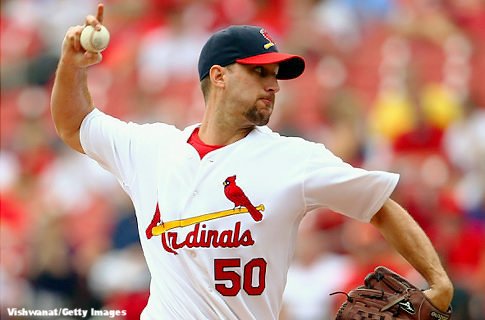
Wainwright2.jpgPitchers and catchers were joined by position players, which meant the next step in the progression toward the 2011 season was to play some Spring Training games. You can put a big check mark by that one as well. Spring is in full swing.

There is a sense of renewal in the air, and I can’t tell you how many times I’ve already heard the phrase, “Hope springs eternal.” Somewhere, there are even long-suffering Chicago Cubs fans saying, “This is the year.”

Now that baseball is back, it’s fun to get caught up in the excitement of the teams in uniform and taking the field with all their new pieces for the first time this year. However, there is a flip-side to that coin. Injury.

The St. Louis Cardinals found out first hand when ace right-hander and perennial Cy Young contender Adam Wainwright was lost for the season after tearing the ulnar collateral ligament in his pitching elbow. It was the latest in a string of events and stories that haven’t exactly instilled confidence in Red Birds camp.  

With the fallout from tabling their very public contract negotiations with superstar first baseman Albert Pujols still echoing around camp, the injury to Wainwright only serves to further dampen the Cardinals spirits. While there’s never a good time, no club wants to have to address a major injury before the season even begins. And there is no way around the fact that this one, quite literally, hurts.

Wainwright will undergo Tommy John surgery on Monday and miss 12 to 18 months, wiping him from the Cardinals rotation for at least one full season. The righty went 20-11 with a 2.42 ERA in 2010, striking out 213 hitters over 230 1/3 innings of work. It was the second year in a row that Wainwright threw as many innings, leading the senior circuit with 233 in 2009. Durability didn’t even begin to speak for Wainwright’s value, but it was certainly a large part of it.

Thousands upon thousands of words have been spilled in newspapers, internet reports, blogs, sports radio, television, and all forms of social media in an attempt to underscore Wainwright’s importance to the Cardinals’ playoff hopes. His loss will place pressure on veteran co-ace Chris Carpenter and 24-year-old lefty Jaime Garcia to carry their load and then some.

The loss of Wainwright will also send the Cardinals scrambling for some sort of replacement, whether internal or via trade. It will be no easy task. Wainwright was the best pitcher not named Roy Halladay in the National League last season. 

No word yet on what exactly Cardinals GM John Mozeliak has planned, but he will do everything in his power to offset the loss and allow St. Louis to contend in what should be a very competitive NL Central race. With the exception of the Pirates, the rest of the division either supplemented their 2010 success with a few new cogs or completely rebuilt their roster with major additions.

The Cardinals added some power in Lance Berkman, but that was done in mind of solidifying the middle of the order and helping put runs on the board for the likes of Wainwright, Carpenter et al. Now the rotation will be reliant on Carpenter and Garcia to anchor the front end, while Jake Westbrook and Kyle Lohse will have to step forward and do a little bit more than simply eat innings and keep the club in the game.

Trade rumors have persisted regarding highly touted center fielder Colby Rasmus, who has not exactly meshed with manager Tony LaRussa. The jury is still out on Rasmus’ path to possible superstardom, but it’s hard to imagine the Cardinals selling low on a young impact bat simply to plug a hole in the rotation. A panic move won’t fix this problem. No overly exciting names are dangling on the free agent market and the trade market is often difficult to project.

Still, Mozeliak will need to get creative. The time is now for the Cardinals to set the tone for the franchise this decade. In more ways than one.


Pujols entering uncharted territory

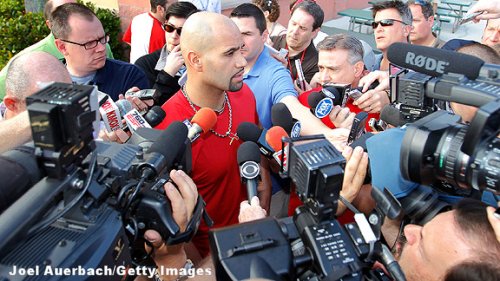
Pujols Media Circus.jpgIt’s not often that the best player in baseball gets to explore free agency in the prime of his career, but when the St. Louis Cardinals failed to come to terms on a contract extension with Albert Pujols by the slugger’s 11 a.m. CDT deadline on Wednesday, it became a very real possibility. Perhaps reality.

As it continues to unfold, reports are indicating that the length of contract was not the biggest roadblock. Instead, all signs are pinning the inability to reach agreement on a difference of opinion over the annual salary figure. SI’s Jon Heyman tweeted that the Cardinals offered a 9-yr deal for more than $200 million, but exact details have been hard to come by thus far.

This entire process brings up a rather interesting question: When you are negotiating with perhaps the best player of a generation, how do you set the market value?

Pujols has done nothing but hit at the highest level in the game since bursting on the scene in 2001. He played left field and third base before settling in at first base, where he has captured three MVP awards and finished second on three other occasions.
Pujols has also won five Silver Sluggers and added a pair of Gold Glove Awards to his ever-expanding trophy case.

While the Cardinals will have an exclusive window to negotiate with Pujols following the season, it remains unclear just how much work is needed to bridge the gap between the two parties. One thing appears to be set in stone, Pujols is not interested in rekindling contract talks at any point between now and the end of the World Series.

The only player to reach free agency possessing a skill set remotely close to Pujols is New York Yankees third baseman Alex Rodriguez. He was able to turn that trip through the employment line into the richest contract in all of baseball. Not once, but twice.

When the Yankees inked the then-31-year-old Rodriguez to his current 10-year $275 million contract in December of 2007, many industry experts cited the obvious effect that it would have when it came time for Pujols to negotiate his next deal. Throughout this process, the A-Rod contract has been the rumored jumping off point for a deal between the Cardinals and Pujols.

I would go into a long and exhaustive study of the numbers between the two, breaking down years of dominance and overall projections of greatness, but I think we can all surmise that both men are supremely talented generational talents. By the time they’ve played their last game, both Pujols and Rodriguez may very well be sitting in the Number 1 and Number 2 spots atop baseball’s all time home run list. The order may be the only question.

Pujols has won three MVP awards in the National League, Rodriguez in the American League. Nine All-Star seasons for Pujols, 13 for Rodriguez. Silver Sluggers? Six for Pujols and 10 for Rodriguez. And, of course, two Gold Gloves for each man.

Those are the kinds of résumés that some players can only dream of, and owners and general managers salivate over adding to their roster. There is absolutely no denying that Pujols’ trip to free agency may end up being the most notable and fascinating such case in baseball history.

Stacking Pujols and Rodriguez side-by-side may be the only peer-to-peer comparison that is available in today’s game. However, the things that Pujols has accomplished in his first 10 seasons in the majors put him in a class all his own. The fact that he will be hitting free agency at roughly the same age as Rodriguez when he cashed in a 10-year deal to stay in the Bronx may suggest that the paths of these two sluggers will remain somewhat similar in yet another aspect.

Pujols has been a stoic figure in Cardinals history despite having some rather large shoes to fill not long after breaking in. Following the retirement of St. Louis legend Ozzie Smith in 1996, Mark McGwire was the face of the franchise in the late 90s. All Big Mac did was break the single season home run record. Pujols was selected NL Rookie of the Year while playing with McGwire in 2001, a season which proved to be McGwire’s final curtain.

For some franchises, the loss of such a prodigious power threat and box office attraction would be a crippling blow. Instead, Pujols stepped in seamlessly and has anchored the heart of the St. Louis order. In 2006, the Pujols-led Cardinals had just enough to capture the NL Central crown and went on to win the World Series. By that time, Pujols was already being anointed as the premier hitter in the game.

St. Louis faces a public relations nightmare should Pujols depart. There is no heir to the throne this time around. When McGwire departed, there was no shortage of sidebar topics that could distract from the luster of his once iconic status in the city. His rapid decline due to knee injury left him just a shell of his former self. Allegations of performance enhancing drug use have all but quieted the mention of the man who inspired the nation to believe in baseball  again, perhaps saving the game in the magical “Summer of ’98.”

True, some club could come along and offer Pujols a mountain of money to leave the only city he has called home. I would guess no less than half a dozen clubs would be willing to put big money offers out there in hopes of wooing him away from St. Louis.

For some reason, I can’t help but feel the Los Angeles Angels of Anaheim, spurned numerous times by 2010 free agents, would be licking their proverbial chops to have a chance to offer Pujols a high-dollar long term deal to head West. Owner Arte Moreno has to be lying in wait, hoping he gets the chance to at least pull out the check book and make an offer.

I can’t speak for Cardinals manager Tony LaRussa, who said the MLB Players Union may have been applying some pressure for Pujols to maximize his value and thereby gumming up the works as it were. That may be true. I somehow doubt that the union is needed to remind Pujols of exactly how valuable he is, and exactly how much money there is to be made in his next contract.

That is exactly the kind of question that Pujols has vowed to avoid throughout Spring Training and all through the 2011 season. He was quite direct when addressing the media around midday in Jupiter, Florida, shortly after reporting to Cardinals camp on Wednesday.

See for yourself (Please excuse any and all video advertisements – a necessary evil to bring you the man himself):

That sounds like a man who is pleased to let all of his talking be done on the field.

Whatever the reason, maintaining a level of respect for the organization, limiting distractions for himself and/or his team, avoiding a media “zoo,” or simply letting nature run its course, Pujols has made up his mind. The negotiations are on a nine-month hiatus.

Till next time,

G-Mc